
The Secondaries Moment
Every market has a moment when something that used to be a niche quietly becomes the default. For private-market secondaries, I think that moment arrived in the last twelve months — and most people outside the industry haven't noticed yet.
Four things happened more or less at once. None of them was a headline on its own. Together they change the picture.
1. The allocation gap
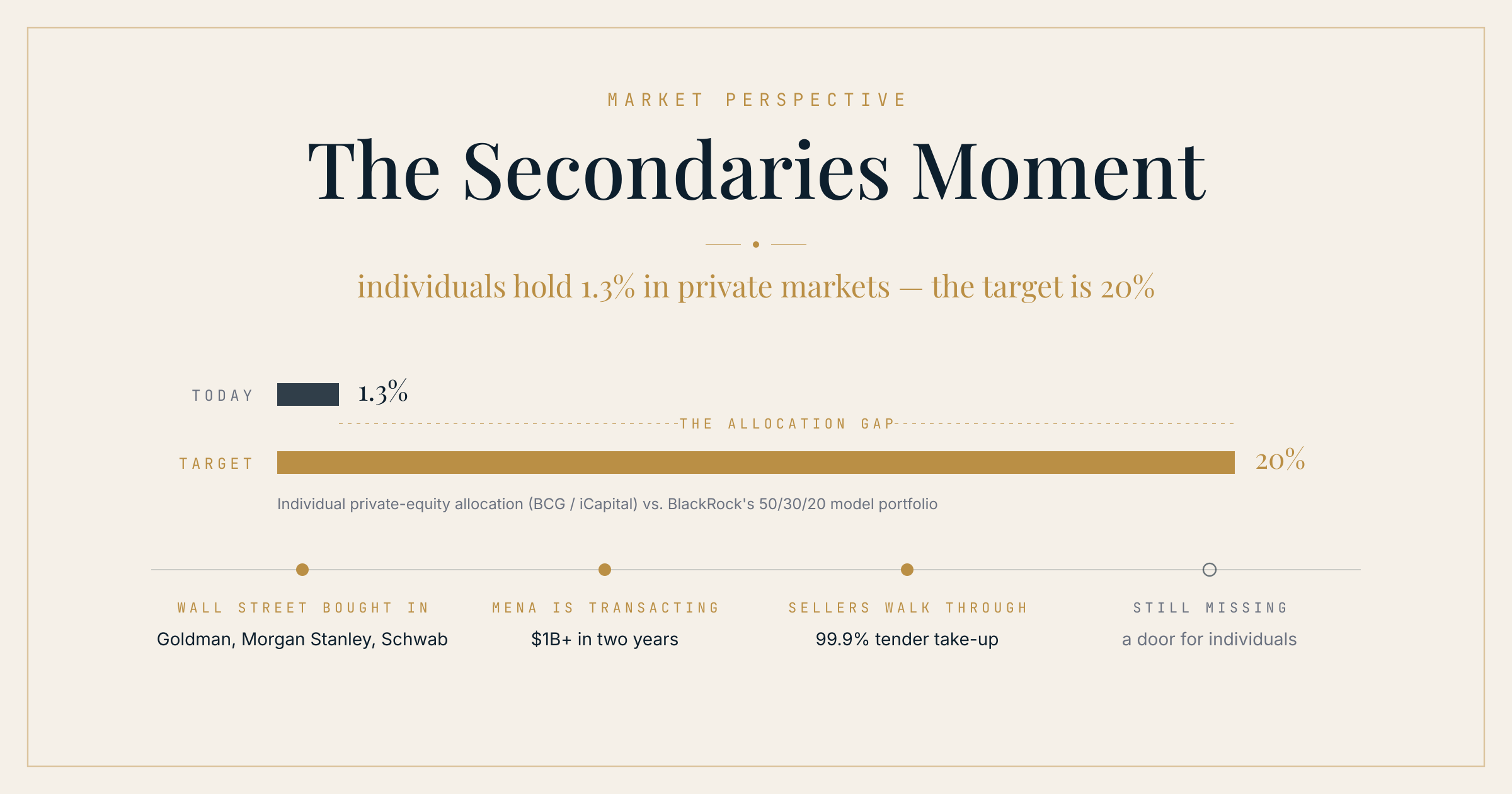
Start with a number that should bother anyone who manages their own money. Individuals — the families, executives, founders, and professionals who together hold roughly $90 trillion in global wealth — have only about $1.2 trillion of it in private equity, by BCG and iCapital's 2025 projection. That's roughly 1.3%, even after growing at 19% a year. Institutions, by contrast, have spent two decades pushing their private allocations into the double digits.
Then, in his 2025 letter to investors, Larry Fink argued that the classic 60/40 portfolio should become 50/30/20: 50% public equities, 30% bonds, and 20% private assets. The comparison isn't perfectly apples to apples — Fink's 20% covers private assets broadly (credit, infrastructure, real estate, not just private equity), while the 1.3% is private equity specifically. But the direction is unambiguous. The world's largest asset manager is telling individual investors that their target allocation to private markets is something like fifteen times where it sits today.
Why now? Because the public market has stopped being where growth happens. The number of listed companies in the US has roughly halved since the late 1990s. Companies now stay private for twelve or fifteen years, and the value created in those years — the part that used to be captured by anyone with a brokerage account after the IPO — is captured by whoever held private shares before it. If you're not in private markets, you are structurally excluded from a growing share of returns. The allocation gap is not a preference. It's a lag.
2. Wall Street voted with its wallet
Stated allocations are easy. What convinced me the moment had arrived was watching the largest wealth platforms in the world spend real money, within weeks of each other, to get there.
In October 2025, Goldman Sachs agreed to acquire Industry Ventures — the $7 billion venture-secondaries specialist — for up to $965 million. Two weeks later, Morgan Stanley agreed to acquire EquityZen, the private-shares marketplace with over 800,000 registered users, explicitly to plug it into Morgan Stanley at Work and its wealth-management clients. A week after that, Charles Schwab agreed to buy Forge Global for $660 million, with a press release that used the word "democratize" in its title.
Three of the biggest names in wealth management, in one autumn, each concluded the same thing: their individual clients need access to private-company shares, and the way to provide it is secondaries — buying existing shares from people who want to sell — rather than waiting for IPOs that may never come. None of them built it. All of them bought it. That tells you how urgent they think it is.
And the supply is there to meet them. Secondary transaction volume hit a record $240 billion in 2025, up nearly 50% year on year, with venture accounting for roughly half. Company-run tender offers are the fastest-growing slice: Carta's platform ran 396 of them in 2025, up 62%, and the median share of demand that sellers were willing to meet climbed to 99.9%. When a window opens, sellers walk through it.
3. It is already happening here
This is the part that matters most for anyone reading from the region, and it's the part I find least appreciated.
MENA's venture ecosystem has spent a decade building companies and almost no time building ways out of them. That started to change in 2024 and 2025, and it changed through secondaries. Tabby completed a secondary share sale in October 2025 at a $4.5 billion valuation, with HSG and Boyu buying from existing shareholders — no new shares issued, no proceeds to the company, just early holders getting paid ahead of a listing. Property Finder has now run three separate liquidity events: a $150 million buyback of VNV Global's stake, the buyout of BECO Capital, and a $525 million block bought by Permira and Blackstone with General Atlantic selling down. Bosta has seen two early investors sell down in the space of three months, one at a 75% IRR and one at roughly 3x. Foodics brought in Kamco Invest ahead of its planned IPO. And to our knowledge, Salla, Zid, Tamara, and Sarwa have each run one or more secondary transactions of their own — deals that didn't make the press but that people in the ecosystem know about.
Add it up and the region has seen over a billion dollars of secondary transactions in roughly two years. The infrastructure is following the deals: SHUAA and Key Capital have launched a dedicated venture-secondaries fund, Afaq Capital bought an entire Saudi VC portfolio in the region's first full portfolio secondary, and Pinnacle has raised a fund that combines Saudi growth rounds with secondary purchases.
Notice what these deals have in common. They are not open-market trades. Every one of them was negotiated, company-aware, and done in a block — an investor selling to an investor, a company buying back its own shares, a founder-led buyout. The region has skipped the chaotic "private stock exchange" phase that the US went through and gone straight to the model that actually works: liquidity that the company knows about and approves.
4. What's still missing
So the demand is forming, the supply is proven, the region's champions are already transacting. What's missing is the layer in between.
In the US, that layer exists. Nasdaq Private Market has run more than 900 company-sponsored tenders. Carta runs hundreds a year. EquityZen — now inside Morgan Stanley — has processed more than 50,000 transactions. There is a mature, well-understood way for a private company to say: this quarter, these shareholders may sell this much, at this price, to these buyers — and for qualified individuals to be on the other side of it.
In MENA, that layer doesn't exist yet. The secondaries that have happened were bespoke, one-off, and available only to the institutions already in the room. An accredited individual in Riyadh or Dubai who wanted to buy Tabby shares in October 2025 had no door to knock on. The marketplaces that tried to be that door were open order books that companies resented and regulators distrusted; most of them have pivoted or shut down.
That's the gap we built Diwan to fill: structured liquidity windows — scheduled, company-approved, time-boxed — on one side, and a curated base of qualified members on the other. It's the same model the US operators proved, built for a region whose companies have just started letting people out.
The moment
I've been writing about private-market liquidity for long enough to be wary of calling a turn. But the four things above are not forecasts. They're things that already happened. The allocation target has moved. The largest wealth managers have bought in. The region's best companies have run their first secondaries. The only piece not yet in place is the one that lets qualified individuals take part — and that is a solvable problem, not a structural one.
The secondaries moment isn't coming. It's here. The question for investors in the region is whether they'll be inside the window when it opens, or reading about it afterward.
This is the market-level view. For how the deals themselves work — who sells, who buys, and how a company keeps control of the process — see The Exit Isn't a Door Anymore. It's a Hallway of Windows.