
Available as:
Book Summary Videos
eBook, Paperback
Audiobook: Spotify, Kobo
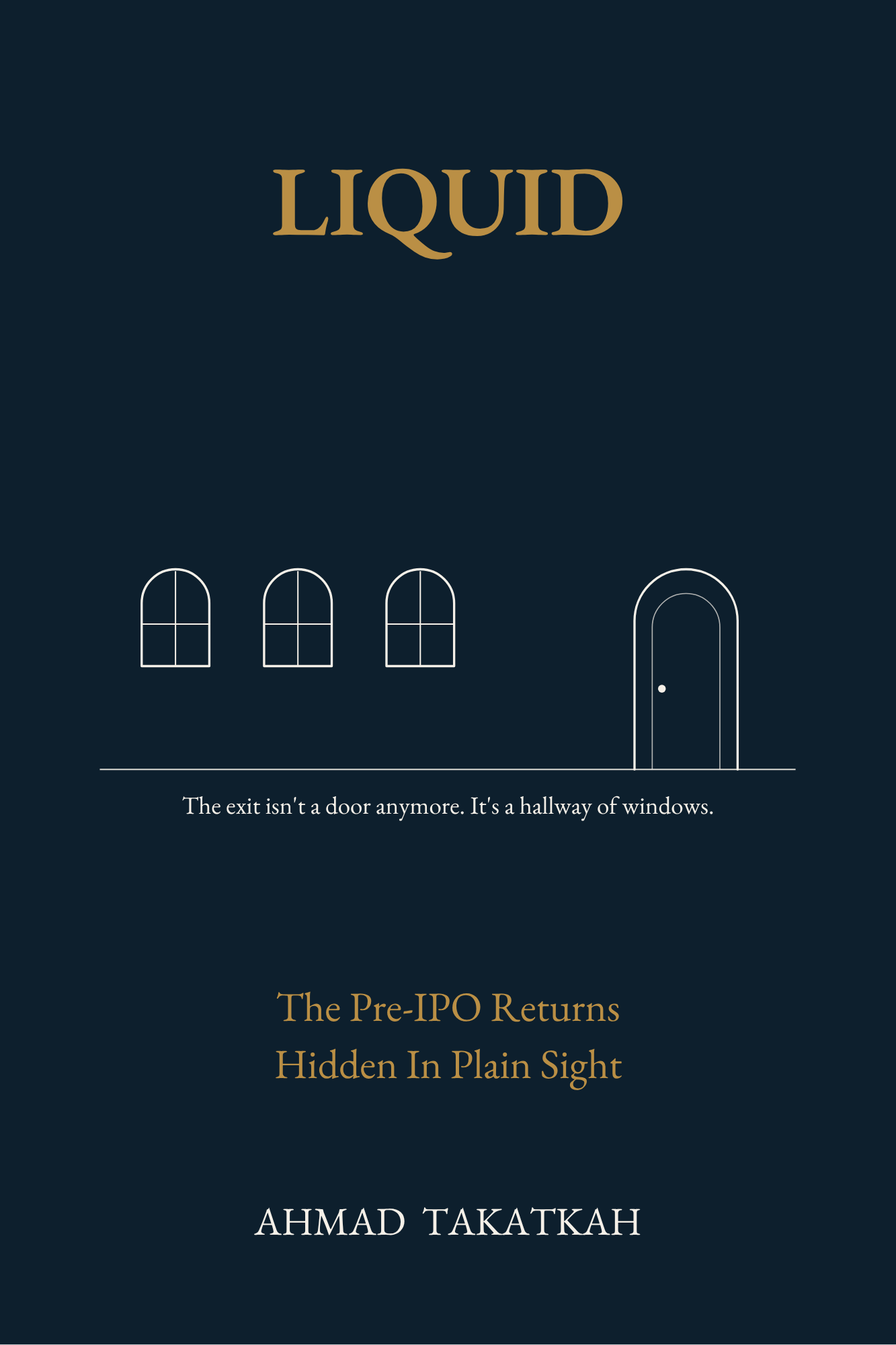
LIQUID
The Pre-IPO Returns Hidden In Plain Sight
Book Summary Videos
eBook, Paperback
Audiobook: Spotify, Kobo
On June 12, 2026, SpaceX went public at $1.77 trillion, and retail investors finally got their chance to buy. The asymmetric returns were already gone, harvested years earlier, behind closed doors, in company-approved liquidity windows most public investors have never heard of.
Here is what changed while nobody was watching: The exit isn't a door anymore. It's a hallway of windows. Private companies now open structured liquidity windows years before anyone rings a bell, and the employees and early backers who once held back now walk through them. Every one of those windows has a buyer on the other side, quietly stepping into growth that used to be reserved for the public markets.
If you are a founder, an executive, an early employee, a banker, a surgeon, a lawyer, or a family office director, you almost certainly meet the legal bar for private markets. LIQUID explains why you were never on the buyer side anyway, and how to get there: the four ways to invest before an IPO, how the windows actually work, what the returns really look like, what can still go wrong, and how to tell a well-built window from an expensive mistake.
I have spent fifteen years at the intersection of startups, venture capital, and data — building equity data products at Carta, running a quantitative venture fund, and building access infrastructure for private markets. The door between "qualified" and "in the room" was never locked by regulation. It was locked by architecture.
The window is open. This book is the map.
Book Summary Videos
eBook, Paperback
Audiobook: Spotify, Kobo
Table of Contents:
AUTHOR'S NOTE: WHY I WROTE THIS BOOK
PART ONE: THE LOCKED ROOM
CHAPTER 1: THE GREATEST WEALTH TRANSFER YOU WERE NEVER INVITED TO
1.1 June 12, 2026: Retail Finally Got SpaceX. The Returns Were Already Gone
1.2 Amazon Went Public at $438M. Uber at $75B. SpaceX at $1.77T. What That Ladder Means for You
1.3 Trillions Locked in Private Companies — and Who's Been Quietly Accessing It
1.4 The Shift That Changed Everything and Nobody Announced
CHAPTER 2: WHY YOU QUALIFIED BUT STILL DIDN'T GET IN
2.1 What "Accredited Investor" Actually Means — and What It Doesn't Guarantee
2.2 The Real Barrier Isn't Regulation. It's Architecture
2.3 How Institutional Investors Built the Infrastructure and Left Everyone Else Outside
2.4 Why This Is Changing Now — and Why the Window Won't Stay Open Forever
PART TWO: HOW THE MARKET ACTUALLY WORKS
CHAPTER 3: THE FOUR WAYS TO INVEST BEFORE THE IPO
3.1 Startup Secondaries — Buying Existing Shares from Founders, Employees, and Early Investors
3.2 Fund Secondaries — Acquiring Stakes in VC Funds at a Discount
3.3 Startup Co-Investments — Getting In on the Same Terms as Institutional Leads
3.4 Fund Allocations — Institutional VC Exposure at Accessible Check Sizes
3.5 How to Think About Which Vehicle Is Right for You
CHAPTER 4: THE LIQUIDITY PARADOX — AND THE INVENTION THAT SOLVED IT
4.1 The Great Mismatch: Trillions in Paper Wealth, Almost No Way to Touch It
4.2 The Average Startup Employee Waits More Than a Decade — and What That Does to People
4.3 Why Ad-Hoc Back-Channel Deals Were Messy, Unfair, and Legally Risky
4.4 Introducing Structured Liquidity Windows — The Concept That Changed the Equation
4.5 The Three Principles That Make SLWs Work: Predictable, Controlled, Strategic
4.6 Why Structure Beats Improvisation Every Time
PART THREE: THE HIDDEN MARKET IN PLAIN SIGHT
CHAPTER 5: THE COMPANIES ALREADY RUNNING WINDOWS
5.1 SpaceX: From $210B to $400B Across Twice-a-Year Tenders
5.2 Stripe: Annual Tenders at $65B, $91.5B, Then $159B
5.3 Replit, Linear, and the New Generation of Founder-Led Liquidity Programs
5.4 What These Companies Have in Common — and What It Tells You About the Market
5.5 The Wild West Years — SecondMarket, SharesPost, CartaX, and the Linqto Bankruptcy
5.6 What the Wreckage Taught Us: Why Company-Approved Windows Won and Exchanges Failed
CHAPTER 6: WHAT THE RETURNS ACTUALLY LOOK LIKE
6.1 Secondary Funds vs Primary VC — The Performance Data That Surprises People
6.2 The Return Gap — What Secondaries Give Up, and What They Get Back
6.3 Loss Ratios — Why Secondary Funds Almost Never Lose Money
6.4 The J-Curve Advantage — Why Secondaries Skip the Pain That Primary Funds Don't
6.5 Hold Periods — What a Shorter Clock Does to Risk
6.6 Being Honest About What Can Still Go Wrong
CHAPTER 7: THE GLOBAL PICTURE — WHERE THE SECONDARY MARKET IS GOING NEXT
7.1 Why the US Market Matured First — and What the Playbook Looks Like for Every Market After
7.2 The New Capital: Sovereign Wealth Funds, Global Family Offices, and the Emerging-Market Investor Class
7.3 The Goldman, Morgan Stanley, and Schwab Acquisitions — What Institutional Consolidation Signals
7.4 Where Growth Is Already Happening: Southeast Asia, the Gulf, Latin America, and Europe
7.5 A Global Regulatory Snapshot — US, UK, EU, Singapore, UAE, and Saudi Arabia
7.6 A Note on Jurisdiction, Exemptions, and Why Platform Structure Matters Wherever You Are
PART FOUR: HOW TO PARTICIPATE
CHAPTER 8: ARE YOU READY? THE ACCREDITED INVESTOR'S SELF- ASSESSMENT
8.1 How Much of Your Portfolio Should Be in Private Markets — An Honest Framework
8.2 Liquidity Needs, Time Horizon, and Why Both Matter More Than Return Potential
8.3 Minimum Check Sizes, Diversification, and Realistic Expectations
8.4 The Tax Conversation You Need to Have Before You Participate
8.5 Qualifying Yourself In — and Knowing When to Wait
CHAPTER 9: HOW PRICING WORKS WHEN THERE'S NO STOCK TICKER
9.1 Why the Last Round Price Is a Starting Point, Not the Answer
9.2 Liquidation Preferences and Why They Matter More Than the Headline Valuation
9.3 The Triangulation Framework — How Serious Buyers Arrive at a Number
9.4 Liquidity Discounts — What They Are, Why They Exist, and What's Fair
9.5 Red Flags in Price Assessment
9.6 What Uniform Pricing Per Class Means for You as a Buyer
CHAPTER 10: HOW TO EVALUATE A WINDOW
10.1 Company Quality Signals — What to Look For When There's No Public Filing
10.2 Pricing Methodology — How to Tell If the Discount Is Real or Manufactured
10.3 Structure Matters — SPV vs Direct, Single-Line Cap Table, Settlement Timeline
10.4 Governance Signals — Is the Company Running This Window or Did Someone Else Initiate It?
10.5 Track Record of the Platform or Operator — Five Questions to Ask Before Committing
10.6 The Risk-to-Guardrail Checklist — A Practical Framework for Every Deal
CHAPTER 11: THE INFRASTRUCTURE OF ACCESS — WHAT TO LOOK FOR IN A PLATFORM
11.1 Why Company Approval Is Non-Negotiable
11.2 KYC, AML, and Why Compliance Protects You as Much as It Protects the Platform
11.3 Clean SPVs, Transparent Economics, and No Hidden Fees
11.4 Why Continuous Trading Platforms Fail — and What Disciplined Windows Do Instead
11.5 The Member Model vs the Marketplace Model — A Fundamental Difference
11.6 How AI Is Changing Platform Intelligence — Matching, Diligence Flags, and Pricing Signals
11.7 What the Right Platform Looks Like — A Checklist
PART FIVE: THE BIGGER PICTURE
CHAPTER 12: WHAT HAPPENS WHEN LIQUIDITY WORKS
12.1 When Founders Get Partial Liquidity They Stop Optimizing for Premature Exits
12.2 When Employees Can Fund Life Events They Stay and Build
12.3 When Accredited Investors Can Participate, Capital Flows More Efficiently
12.4 The Ecosystem Effect — Why SLWs Are Good for Startups, Not Just Investors
12.5 From Crisis Management to Competitive Advantage — The Culture Shift
CHAPTER 13: THE FUTURE OF PRIVATE MARKETS
13.1 Tokenization — What It Actually Means for Secondary Liquidity and What It Doesn't
13.2 Regulatory Evolution — Where the SEC, CMA, and Global Bodies Are Heading
13.3 How AI Is Reshaping Diligence — What Individual Investors Can Now Do That Only Institutions Could Before
13.4 AI-Driven Market Discovery — How Intelligent Platforms Are Closing the Information Gap
13.5 The Global Secondaries Market in 2030 — A Considered Forecast
13.6 Who Will Build the Infrastructure — and What That Means for You
CONCLUSION: THE WINDOW IS OPEN
ACKNOWLEDGMENTS
ABOUT THE AUTHOR
GLOSSARY
NOTES AND REFERENCES
Available as:
Book Summary Videos
eBook, Paperback
Audiobook: Spotify, Kobo