
Fifteen years ago, selling shares in a private company meant finding a buyer yourself, persuading the company to approve the transfer, and paying a lawyer to paper it. In the US, that problem has been almost entirely industrialized. Marketplaces, tender-offer operators, data providers, and dedicated secondary funds now handle a huge market of direct venture secondaries, and three of Wall Street's largest firms bought their way into it within a single autumn.
Outside the US, most of that infrastructure does not exist. This piece maps what does: six categories of player, who the US exemplars are, what exists in the Gulf, India, and other emerging markets, and where the gaps are.
A disclosure before the map. I run Diwan Capital, which operates in one of the six categories below. I have tried to describe every company here, including competitors, the way their own founders would. Where I have an interest, I say so.
Why the US market matured when it did
Three forces built the US secondaries industry. Companies began staying private far longer, so employees and early investors accumulated paper wealth with no exit. A handful of enormous names (SpaceX, Stripe, OpenAI, Anthropic, Databricks) created retail-grade demand for private shares. And after a decade of scandals and shutdowns, companies learned that unmanaged secondary trading in their stock was worse than managed trading, which pushed them toward sanctioned programs.
The result, by 2026, was a market with several distinct layers. What follows is a taxonomy, not a ranking. The categories overlap, and the largest players now span more than one.
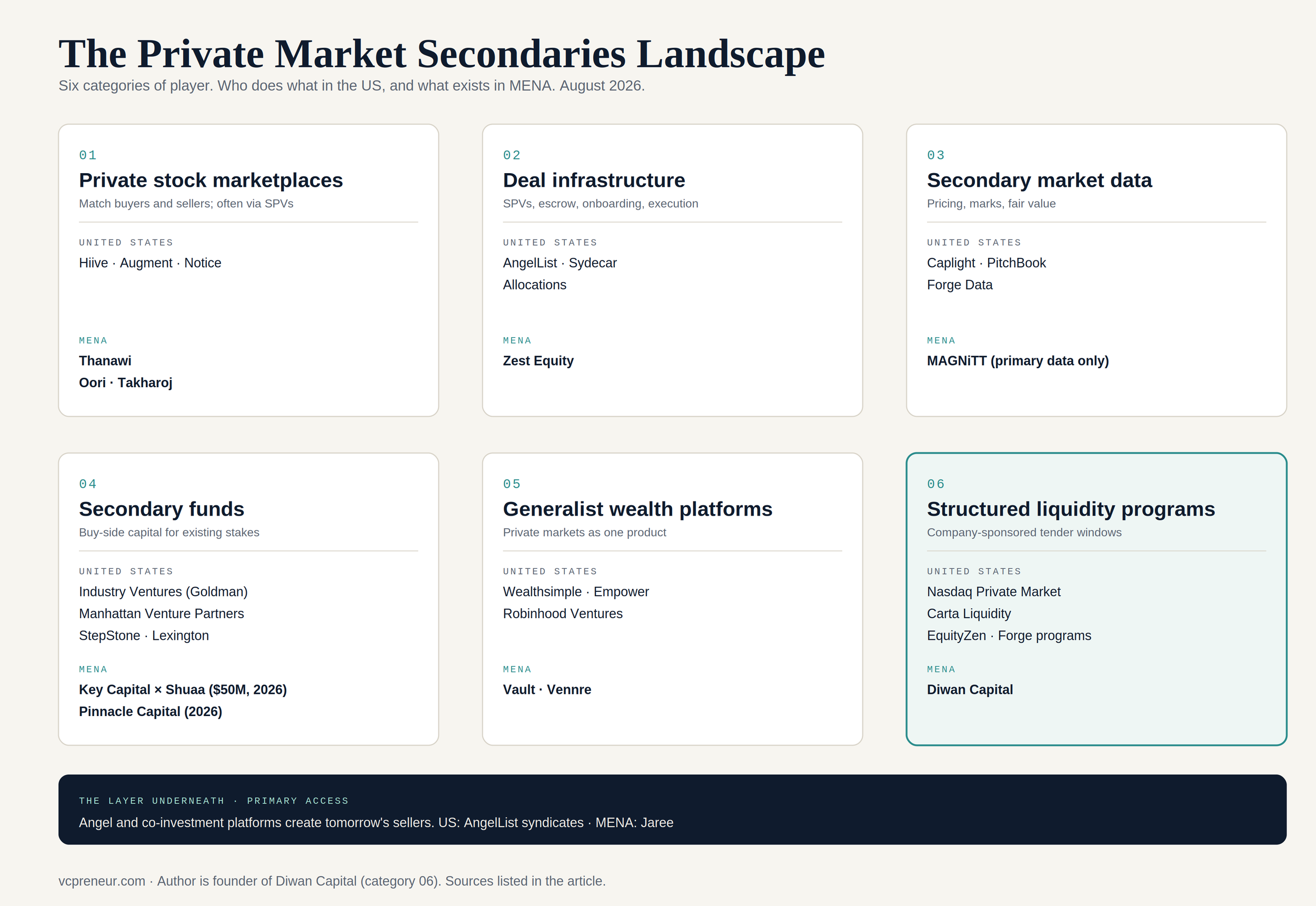
The six categories
1. Private stock marketplaces
What they do. Match buyers and sellers of shares in specific private companies. Many with continuous trading platforms, use nested special-purpose vehicles (SPVs) so the buyer owns a unit of a fund that holds the stock, which avoids the company's transfer restrictions.
US players. Hiive, Augment, Notice.
What changed. This category has a long list of casualties, and they tell you something about its structure. CartaX, Carta's attempt at an exchange for private shares, was wound down in Jan 2024. Linqto, which sold SPV units in pre-IPO companies to roughly 13,600 customers, shut its platform in March 2025 after discovering what its own CEO called serious defects in how it was structured, filed for Chapter 11 that July, and had a liquidation plan confirmed in February 2026. The common thread across the shutdowns is that open marketplaces solved discovery but not consent: they made it easy to find a buyer and hard to guarantee the company would let the shares move, or that the buyer would actually own what they paid for.
In MENA. Thanawi matches shareholders and investors in Saudi private companies. Oori and Takharoj have operated similar models. Zest Equity started as a transaction and secondary platform and has since repositioned itself as infrastructure (see category 2). None yet operates at the scale of the US platforms, and the regulatory treatment of these matching models varies by country.
2. Deal infrastructure
What they do. The plumbing: SPV formation, escrow, investor onboarding, KYC, cap table updates. They don't source deals; they make other people's deals executable.
US players. AngelList, Sydecar, Allocations.
In MENA. Zest Equity, based in DIFC, now describes itself as digital infrastructure for private-market transactions: SPVs, FSRA-regulated escrow, and regulated arranging in one workflow. This is the cleanest example in the region of a company moving from the marketplace layer to the infrastructure layer.
3. Secondary market data
What they do. Price discovery. Indicative bids and offers, completed-trade marks, 409A inputs, and increasingly fair-value models for portfolios that have to be marked quarterly.
US players. Caplight, Forge Data (now inside Schwab), PitchBook, and the data arms of the tender operators.
In MENA. MAGNiTT tracks funding rounds and valuations across MENA, Africa, Turkey, and Pakistan, but there is no regional source of secondary pricing data, because there are not yet enough trades to build one. This is a gap, and whoever runs enough transactions first will own it.
4. Secondary funds
What they do. Buy-side capital. Funds that specialize in buying existing stakes, either directly in companies or as LP interests in other funds, often at a discount.
US players. Industry Ventures (now part of Goldman Sachs, at $665 million plus up to $300 million in earn-out), Manhattan Venture Partners, StepStone, Lexington, and dozens of others.
In MENA. This category arrived in 2026. Shuaa Capital and Key Capital launched a $50 million venture secondaries fund in May, structured as an ADGM limited partnership and described as the region's first; it targets shares held by founders, employees, and angels rather than LP positions. In August, Pinnacle Capital launched a Saudi fund combining growth rounds and secondary purchases. Both are small by US standards and both are significant, because a buyer of last resort is what makes every other category possible.
5. Generalist wealth platforms
What they do. Digital wealth managers that have begun adding private-market access as one product among many.
US players. Wealthsimple, Empower, Robinhood (which priced a ventures fund in March 2026), and the bank-owned platforms above.
In MENA. Vault, Vennre, and many others are building wealth-tech products for Gulf investors with some private-market access. The relevant question for all of them is distribution: they reach the investor but need someone else to source and structure the deals.
6. Structured liquidity programs
What they do. Company-run or company-approved events, usually tender offers, where the company sets the terms, approves the buyer, and lets employees and early holders sell a portion of their shares in a single, time-boxed window. The company controls its price and cap table; sellers get a clean process; buyers get a sanctioned transaction.
US players. Nasdaq Private Market is the reference point. It executed nearly $15 billion in tender-offer volume in 2025, up from about $3 billion in 2023, and has run more than 900 company-sponsored programs for over 200,000 shareholders. Carta Liquidity runs tenders for companies already on Carta's cap-table software; its 2025 report cites 396 tenders, up 62% year on year. EquityZen and Forge pivoted to run company-sponsored programs now.
This is the category that grew fastest in the US, for a structural reason: it is the only model where the company is a willing participant. NPM's own data point, that companies are now running tenders earlier in their lives rather than only at the pre-IPO stage, is the clearest sign that structured liquidity has become a standard tool rather than a late-stage exception.
In MENA. Almost nothing. Isolated company-run secondaries have happened: over the last two years, companies including Salla, Zid, Tabby, Tamara, Foodics, Property Finder, Sarwa, and Bosta have completed one or more secondary sales, most of them investor-to-investor transactions negotiated around funding rounds rather than broad employee windows. There is no regional operator running structured tender programs at scale.
This is the category Diwan Capital is building in: company-approved liquidity windows for MENA and emerging-market companies, modeled on the US tender-offer process. I'll leave the assessment of whether that's the right bet to readers; the point of this piece is the map, and the map shows the category is empty.
The regional picture beyond the Gulf
A rough sketch, which I'd like corrected by people in each market:
India has the most developed emerging-market secondaries activity. ESOP buybacks are now a common retention move at well-funded companies, often run by the company itself. There is visible secondary trading in a few dozen names and several platforms serving it. Foreign-buyer rules remain a recurring constraint.
Southeast Asia has activity concentrated around the largest names (the Grab and Sea generations and their successors), little below them.
Latin America and Africa are earlier still. Currency risk and transfer restrictions add a layer that US buyers never have to consider.
Turkey and Egypt have large pools of qualified investors and a handful of late-stage companies, with secondary activity mostly negotiated privately.
What the map says
Three things stand out.
First, the US is consolidating upward. When Schwab, Morgan Stanley, and Goldman each buy a layer of the stack in one season, the independent marketplace era is ending and private shares are becoming a wealth-management product. The interesting question for everyone else is which layers remain open for independents, and the answer in the US seems to be data and structured programs, not matching.
Second, the emerging-market stack is being built in a different order. The US built marketplaces first, then tender programs, then dedicated funds. MENA got infrastructure and early marketplaces, then its first dedicated fund in 2026, and still has no structured-liquidity layer. That order matters, because the buy-side capital now exists before the process for deploying it does.
Third, the constraint in emerging markets isn't demand or supply. The Gulf alone has a large population of qualified investors and a growing bench of companies with eight- and ten-year-old option pools. What's missing is the sanctioned process that connects them, and the regulatory clarity that lets it run. That's true in Riyadh and Dubai today the way it was true in San Francisco around 2012.
I'll keep this map updated as the landscape changes. If I've mischaracterized your company, or missed one, tell me and I'll fix it.
Sources
Charles Schwab completes acquisition of Forge Global (March 2, 2026): https://pressroom.aboutschwab.com/press-releases/press-release/2026/Charles-Schwab-Completes-Acquisition-of-Forge-Global/default.aspx
Forge 8-K on merger close: https://www.sec.gov/Archives/edgar/data/1827821/000182782126000010/forge8-kschwabmergerclose.htm
Morgan Stanley acquires EquityZen: https://www.wealthmanagement.com/wirehouse-news/morgan-stanley-buys-equityzen-in-first-deal-for-ceo-ted-pick
Morgan Stanley halves private-share trading fees: https://www.wealthmanagement.com/alternative-investments/morgan-stanley-slashes-prices-for-clients-trading-private-shares
Goldman Sachs to acquire Industry Ventures: https://www.fintechfutures.com/m-a/goldman-sachs-agrees-to-acquire-industry-ventures
PitchBook on EquityZen and direct secondaries volume: https://pitchbook.com/news/articles/morgan-stanley-snaps-up-equityzen-in-wall-streets-latest-secondaries-vc-push
PitchBook, "The $120 billion market for coveted pre-IPO stock enters its scaling era": https://pitchbook.com/news/articles/the-120-billion-market-for-coveted-pre-ipo-stock-enters-its-scaling-era
Linqto bankruptcy (Reuters): https://finance.yahoo.com/news/private-investment-platform-linqto-files-105229723.html
Nasdaq Private Market 2025 tender volume: https://www.nasdaqprivatemarket.com/nasdaq-private-market-announces-first-ever-employee-tender/
Shuaa and Key Capital venture secondaries fund: https://enterpriseam.com/uae/2026/05/12/shuaa-key-capital-launch-the-regions-first-venture-capital-secondaries-fund/