
On building products, catalogues, and APIs for the AI agents that now sit between you and the human.
Revora's raise is a cleaner peg than it looks. The Saudi startup (formerly MyAlice) closed a $2M seed in June and reported revenue up 10x since it pointed itself at the GCC in late 2024. Good story. Not the interesting one.
The interesting one is a line the founders keep repeating: the merchants who win the next decade are the ones an AI can understand, represent, and sell for. Reads like a tagline. It's actually a bet about what a moat is. Revora turns each merchant's catalogue into clean structured data and calls the pile of it a commerce graph, one it claims no messaging vendor, helpdesk, or model provider can replicate.
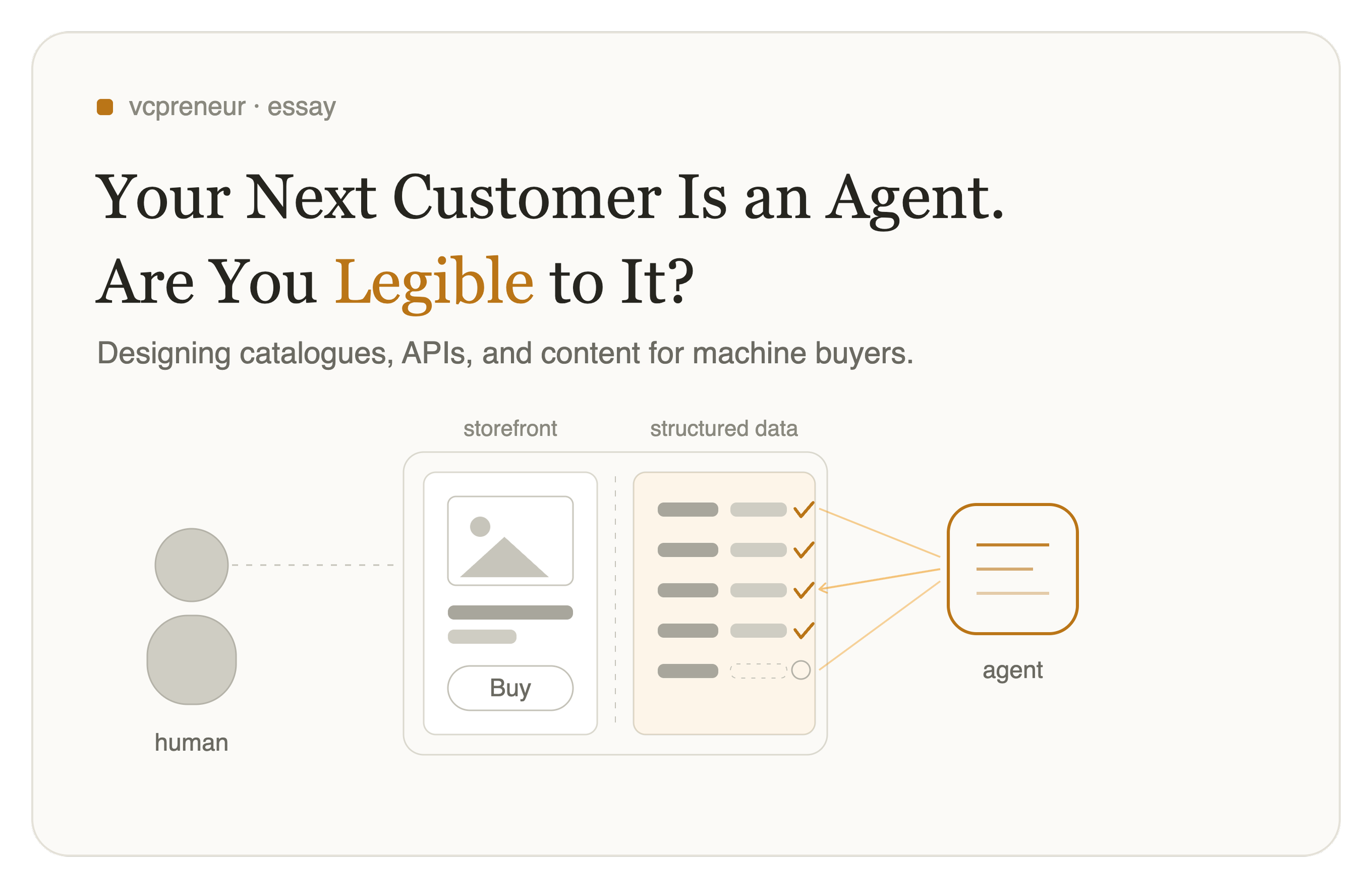
That inverts twenty years of received wisdom. For most of the last two decades, the moat in commerce was the funnel to the human: brand, UX, the icon on the home screen, the checkout flow A/B-tested to the third decimal. One machine, pointed at one target, human attention. Revora's bet is that the target moved. The question isn't whether you can catch a shopper's eye anymore. It's whether an agent can parse your data, trust it, and buy against it on the shopper's behalf.
Call it legibility. The shift underneath it is easy to say and hard to swallow: you're building for the agent now, not the human.
The moat stopped pointing at anyone
Everything you built to win a person is aimed at faculties an agent doesn't have. It has no eye to catch. It doesn't feel your brand, doesn't respond to your urgency banner, doesn't abandon a cart because the checkout felt clunky, it either completes the transaction programmatically or it can't. When an agent sits between you and the buyer, most of the persuasion machine you spent a decade tuning points at no one.
What the agent does have is a parser and a trust threshold. It reads structured data. It checks whether your prices, inventory, variants, and return policy are machine-queryable and consistent. Then it decides, on criteria you don't fully control, whether to surface you and route money to you. Persuasion gives way to legibility. The job changes from making a human want you to making a machine able to represent you.
The plumbing is already here
In September 2025, OpenAI and Stripe shipped Instant Checkout in ChatGPT on the Agentic Commerce Protocol, an open standard that lets an agent buy inside the chat without the shopper ever touching your site. Meta joined as a co-author. Google countered with its own coalition-backed protocol wired into Gemini and Search's AI Mode. Anthropic's tool-calling standard went to a Linux Foundation body in December.
Then the card networks moved, on the same day. On June 10, 2026, Visa said tokenised credentials could power agent checkout inside OpenAI's products; hours later, at a different conference, Mastercard launched Agent Pay for Machines for agent-to-agent transactions down to fractions of a cent. Two of the largest payment networks on earth crossed from pilot to infrastructure within hours of each other, uncoordinated. That's the signal.
For a merchant it all shakes out into a checklist that didn't exist three years ago: a structured feed, an API checkout, an agent/trust registration, payment delegation, a consumer authorization trail. Most merchants have none of it, just a pretty storefront an agent can't query. The gap between "has a nice website" and "is transactable by a machine" is the whole game.
And there's a tollbooth going up on top: OpenAI takes 4% on completed Instant Checkout purchases. That number tells you the agent layer expects to be paid for delivering buyers, which tells you where the power is pooling. Hold that thought.
This was never really about commerce
Commerce is just the clearest version of a pattern showing up everywhere the human used to sit at the interface. Same move, three fronts.
Discovery. Being found used to mean ranking a blue link on page one. Now it means being cited inside a synthesized answer, the thing marketers clumsily call GEO. Same structure: the human never sees your page; a model reads it and decides whether to name you. And the two systems have decoupled, the overlap between top Google results and AI-cited sources has reportedly fallen from around 70% to the low 20s. Ranking no longer buys the citation. What buys it is the same thing agent-legibility buys in commerce: extractable, dense, dated, structured claims a machine can lift.
Software. The GUI was the product. The onboarding flow you polished for a quarter is invisible to an agent that just wants the endpoint. The question now is blunt: can your product be called by an agent, not scraped, not summarised, called programmatically? The clean, permissioned API is becoming the product surface. Beautiful software with no machine-legible way in is a gorgeous shop window on a locked door.
Machine-to-machine. The strange one, and where the best products get built. Your outbound agent increasingly reaches their inbound agent, an AI caller hits a receptionist agent, not a human gatekeeper. The qualification, the triage, the booking collapses into agent-to-agent. The design problem becomes making your agent trustworthy and interoperable to other agents. Anyone building in voice or outbound is already on this front, named or not.
The honest tensions
If this were pure tailwind it wouldn't be worth writing. Three reasons to hold the bet loosely.
It's early and thin. Walmart's ChatGPT-checkout test reportedly converted about 3x worse than just redirecting shoppers to Walmart.com, and OpenAI retired its first Instant Checkout in March 2026 for dedicated retailer apps. Forecasts disagree by an order of magnitude, Morgan Stanley in the low hundreds of billions, a McKinsey/ICSC projection touching a trillion in US retail by 2030. Building for a buyer that barely transacts yet is a duration bet, and duration bets are how well-positioned startups die of good timing that shows up late.
Commoditisation. If agents pick on machine-legible attributes, price, spec, availability, rating, you compete away the premium the brand used to command. The counter-read: the human relationship, the one thing the agent can't fully commoditise, gets more valuable, not less. "Build for the agent" is not "abandon the human," and founders who confuse the two hand their margin to a router.
The landlord problem. Every protocol reassures you that you stay the merchant of record. That reassurance is doing a lot of work. Whoever owns the agent owns the shelf and sets the toll, the 4% is an opening number. We've seen this movie: the App Store, Amazon's marketplace, Google Shopping. "Build for the agent" can quietly mean "build for a landlord who'll eventually tax you." So the real question isn't just am I legible, it's am I legible on rails I'm okay being captured by.
Why this is a MENA story, not a macro one
Start with a detail in Revora's own pitch: its agents sell in the customer's Arabic dialect. That points at an asymmetry most agent-commerce takes miss. The unstructured signal Western merchants lean on, decades of reviews, long-tail content, SEO'd pages, is far thinner in Arabic. Which flips the logic. In a market where the ambient data an agent could infer you from barely exists, structured data isn't a nice-to-have; it's the only way a machine finds and trusts you. The catalogue moat is bigger here precisely because the surrounding data is thinner.
Then the leapfrog: GCC merchants carry less legacy human-web infrastructure to unlearn. The region skipped to mobile-first and cloud-first; agent-native is the same jump with less sunk cost fighting it.
And the investable part: the rails are being defined right now, mostly around US card networks and English. The GCC has its own fast payment infrastructure and its own platform champions, Salla, Zid, the regional marketplaces. Whether they adopt the US-defined stack, adapt it, or get quietly captured by it is an open question with a closing window. Wet cement hardens. There's a real opening for GCC-native legibility and agent-rail infrastructure, but only before the defaults set.
The Reframe
For a decade the question was how do I win the human's attention? The next decade's version is am I legible, trustworthy, and transactable to the machine that now holds it?
That's not a marketing tweak. It changes what a catalogue is (a moat, not a spreadsheet), what an API is for (a storefront, not plumbing), what your content optimises toward (a citation, not a click), and who your actual customer is. Get it early, while the protocols are still wet, and you help set the defaults. Wait, and you'll relearn the oldest lesson of every platform era: legibility on someone else's rails is a rented moat, and the rent only goes up.
Your next customer is an agent. The only question that matters is whether it can read you.