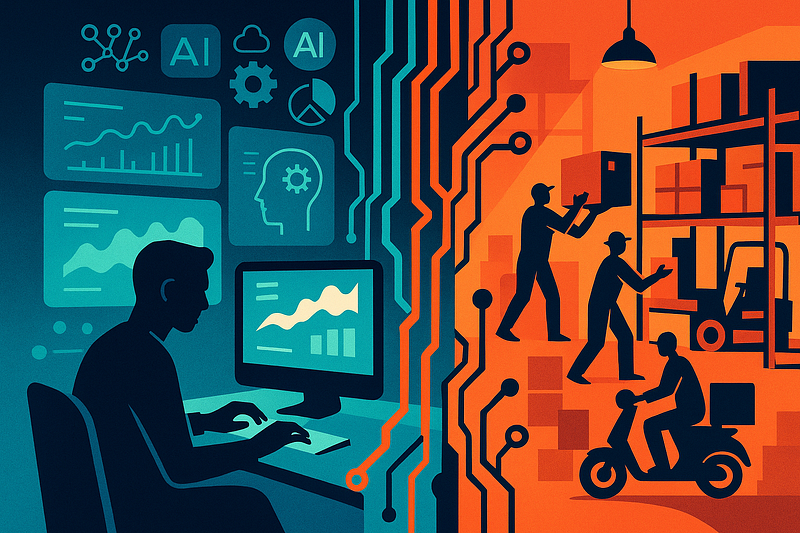
You’re Not a Tech Startup Anymore
You’re Not a Tech Startup Anymore
And That’s Okay, But …
In the early days of any new technology, almost everyone playing on the edge gets called a “tech company.” Then time passes, the tools mature, and what used to be an edge quietly becomes infrastructure.
But a lot of founders (and investors) keep acting like we’re still in the early days. That’s where the misalignment comes from: wrong capital, wrong expectations, wrong strategy.
They misprice risk, mislabel the business, and choose the wrong capital — all because they’re stuck in an earlier phase of the tech cycle.
This isn’t just semantics. It affects:
- How much you raise
- From whom
- At what valuation
- And what your realistic growth expectations, exit paths, and return potential are.
Let’s unpack this for tech companies vs tech-enabled companies…
When Having a Website Made You “Tech”
There was a time when selling online was a true technical moat.
Building a website, integrating payments, handling basic logistics and customer experience, that was hard. There were no drag-and-drop builders, no plug-and-play Shopify, no ready-made playbooks. If you managed to sell online, you were by definition operating at the frontier of what was technically possible.
Fast-forward to today, having a website is not a “tech edge.” It’s as basic as having a logo for your shop. Not having one is a red flag. E-commerce didn’t stop being valuable. It stopped being differentiating.
The same thing happened with online payments:
- Then: integrating card payments was painful. You needed custom bank integrations, PCI compliance, and proper engineering.
- Now: you drop in Stripe or any similar infra company, copy some docs, and you’re live.
It happened with SMS/OTP, too:
- Then: getting reliable SMS through telcos was a dark art.
- Now: Twilio (or similar) turn it into a clean API call.
And with GPS tracking and mapping:
- Then: accurate consumer GPS + routing + maps was frontier stuff in Uber’s early days.
- Now: it’s a library import.
In each case, the pattern is the same: What starts as “wow, this is hard tech” ends up as “of course you have this, everyone does.”
The tech moves from edge → advantage → table stakes → commodity.
The problem is: many founders and investors don’t update their mental model when that happens.
Uber as a Case Study in Tech Commoditization
In the early days, Uber really was a tech startup:
- Real-time GPS tracking on consumer phones
- Dynamic rider–driver matching
- Routing and pricing at scale
- Integrated payments and trust systems
None of that was trivial. You couldn’t just buy a “ride-hailing-in-a-box” product. Today, if a new company in one city says: “We’re like Uber, but for X” …and what they mean is:
- A standard rider app
- A standard driver app
- Google Maps routing
- Commodity payment rails
…then this is no longer frontier tech. It’s implementation.
That company is fundamentally:
- A transportation & logistics business, running a tech-enabled operation, and built on commoditized components
That’s not an insult. It’s just not the same animal as Uber in 2011 — and it shouldn’t be funded or valued the same way.
Fintech: Real “Tech” vs Pretty Front-End
You see the same dynamic in fintech.
There are fintech companies where the core of the business is truly technical:
- New underwriting models using proprietary data
- Real-time risk engines and fraud detection
- Optimized payment routing, FX, or treasury infra
- APIs and rails that other companies use & build on
If you rip out the tech, the company dies. The code is the business.
Then there’s the other camp:
- A beautiful app
- On top of a BaaS provider or aggregator
- With simple risk rules and a manual back office
- And no real data or infrastructure moat
If you rip out the tech, the business still kinda works. It’s slower and uglier, but it’s fundamentally a lending or payments company that uses tech — it doesn’t embody it.
That’s a tech-enabled financial services business, not a core “tech startup” in the deep sense.
Still potentially great. Just a very different risk/return profile.
The Tech Edge Has a Half-Life
The core mistake I see:
People treat “tech” as a permanent identity instead of a temporary edge.
In reality, every tech edge has a half-life:
- Invention phase — Very few can do it; just being able to ship it is a moat.
- Advantage phase — A handful of teams can do it; tech + execution give you an edge.
- Table-stakes phase — You must have it to compete, but having it doesn’t differentiate you.
- Commodity phase — You rent it from vendors; it’s infra.
- Legacy phase — If you cling to old stack, your “tech” becomes a liability.
We’ve seen this movie many times:
- Websites and basic e-commerce
- Online card payments
- SMS and OTP
- GPS tracking and routing
- Video streaming and encoding
- OCR and basic document scanning
- Simple recommendation engines
All of these were once real “tech startup” territory. Now they’re just plumbing.
Today’s Frontier, Tomorrow’s Plumbing (AI Edition)
The cycle isn’t over. It’s happening again — in AI.
A few examples that today still sound like an edge but will age into infrastructure:
1. LLM-Based Chat Assistants
Now:
“We built an AI assistant on GPT/Claude that helps users do X.”
Soon:
Every product has some sort of AI chat or copilot by default. It’ll be like having a search bar.
Takeaway:
The edge won’t be “we have an AI chat.” It’ll be your data, workflow integration, and outcomes.
2. AI Customer Support
Now:
“AI handles 40% of our support tickets.”
Soon:
Companies like OpenCX and others are already providing this as infra, and can ship robust AI support as standard. Everyone will have roughly the same first-line AI.
Takeaway:
The advantage moves from “we use AI” to how you design your processes, training data, escalation paths, and customer experience.
3. “AI Copilots” Inside SaaS
Now:
“We have an AI copilot that helps you write, summarize, and analyze.”
Soon:
Every serious SaaS product will have some built-in copilot. Users won’t choose your tool because you have one; they’ll assume it.
Takeaway:
You’ll win on depth of workflow, domain understanding, and real productivity gains, not the word “copilot” in your deck.
4. AI Content Generation
Now:
“We auto-generate blog posts, emails, and ad copy.”
Soon:
Every marketing platform will offer that. The internet will be full of AI sludge.
Takeaway:
The edge will move to strategy, distribution, voice, and targeting, not the act of generating words.
5. Vertical “AI for X” Wrappers
Now:
“AI for lawyers/doctors/recruiters/creators” built on top of the same general models.
Soon:
Horizontal AI tools and incumbents will have strong offerings for each profession. Many wrappers converge into similar capabilities.
Takeaway:
The winners will be those who own distribution, data, and deep workflow integration, not just a UI on an API.
All of these are today’s “tech startup” stories that risk becoming tomorrow’s “tech-enabled feature” stories.
Where Investors Get Trapped
Investors get into trouble when they underwrite as if we’re still in phase 1–2, while the market has already moved to 3–4.
- In 2013, “We’re an on-demand delivery app” justified a tech multiple and hyper-growth bets.
- A decade later, the 7th delivery app in one city, built on the same playbook and infra, is closer to: A logistics/operations business, with thin margins, labor risk, and local competition, running on commoditized tech.
Same with:
- The 5th BNPL product built on the same lending rails
- The 6th “AI for X” using the same underlying models
- The 10th neobank in a market using the same BaaS stack
But because:
- The first winner in the category was a true tech company, and
- The buzzword is still hot
…late entrants get misclassified — and mispriced.
LPs think they’re getting exposure to “tech.” In reality, much of the exposure is to operational complexity, local execution, and commoditized tools.
A Simple Test: Tech Startup or Tech-Enabled?
Here’s a rough but useful diagnostic for founders and investors.
- If we turned off all our proprietary tech and replaced it with off-the-shelf tools, how much of the business would still work?
- If 70–80% still works: you’re likely tech-enabled.
- If the business collapses: you’re closer to a true tech startup.
2. Can someone else buy our “secret sauce” as SaaS from another vendor?
- If yes, and it wouldn’t fundamentally change your economics or operations, then you’re using tech as infrastructure, not as a moat.
3. Do our margins and scalability look like software or like operations?
- Do we add revenue without linearly adding people and physical assets?
- Or do we need more kitchens/drivers/branches/underwriters with every step up?
4. Does our edge get stronger with time because of data and network effects, or weaker as others adopt the same tools?
- True tech edges compound.
- Commodity tools leak advantage.
5. If we stripped all buzzwords, what are we honestly?
- A bank? Logistic operator? Retailer? Agency? Clinic? School?
- Sometimes that answer tells you more than “fintech” or “AI startup” ever will.
This is the simplest Capital Alignment test.
Being Tech-Enabled Is Not an Insult
None of this is meant to belittle tech-enabled businesses.
A lot of the best companies in the world are:
- Operationally excellent
- Boring on the surface
- Obsessive about customer value
- Ruthless on unit economics
They use tech aggressively, but not as cosplay — as a tool.
Those companies might be far better suited to:
- Revenue-based financing
- Private credit
- Growth equity / PE
- Or simply: profitable, compounding cashflows
…than to hyper-growth VC.
The problem isn’t that there are too many tech-enabled companies. The problem is that we label them all as “tech startups,” then punish them for not behaving like one.
The Thin Line (And Why It Matters)
Here’s the real distinction:
A tech startup is defined by technology that is the business — it creates the moat, drives the margins, and scales non-linearly.
A tech-enabled company is defined by a business that could exist without proprietary tech, but uses it to operate cheaper, better, faster, or smarter.
As technology evolves, companies cross that line all the time:
- Some start as true tech startups in a frontier space.
- The category matures, the edge decays, infra gets commoditized.
- What’s left is a tech-enabled operator in a mature market.
That’s normal. That’s healthy.
What’s dangerous is pretending the crossing never happened — and still funding, pricing, and storytelling as if we’re in the early days.
If you’re a founder, be honest about where you are on that curve.
If you’re an investor, be honest about what you’re actually investing in.
Not every great business needs to be a tech startup. But every serious founder and investor needs to know the difference.