
The Ultimate Guide On All Investment Fund Types (+ Crypto Funds)
The Ultimate Guide On All Investment Fund Types (+ Crypto Funds)
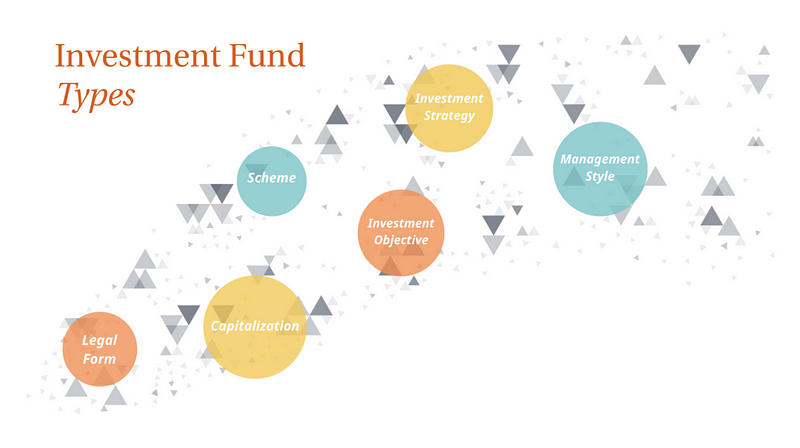
There are so many fund types out there, and as if we don’t have enough to be confused, there are now even more types for crypto funds.
In this post, I will go through all types explaining the bases for classifications and the differences between all types.
The key here is on what basis do you classify funds:
Funds can be classified based on their legal form, capitalization, fundraising scheme, investment objective, investment strategy, and management style.
The below Prezi presentation: Investment Fund Types, shows all these classifications and the related fund types. Below the presentation, you can read the details about each type.
Funds By Legal Form:
Mutual Funds vs. Hedge Funds
A mutual fund is basically a highly regulated investment company. This company can advertise freely and hence it can raise money from the public (anyone can invest).
A hedge fund is more private, hence is relatively less regulated, it can not advertise to anyone as it can only accept money form accredited investors.
Hedge funds are more flexible when it comes to investment strategies, they can sell short, use derivatives & leverage and they can change their strategies as they see fit. Mutual funds can’t, they’re much more restricted.
Hedge funds are less liquid, if you invest you can’t take back your money at anytime, but at a mutual fund usually there is daily liquidity.
Lastly, mutual funds are obligated to disclose their holdings to their investors periodically, but Hedge funds can chose not to disclose their holdings or investments, they usually only share their strategies and returns but not the details of their holdings.
When it comes to fees, mutual fund managers charge investors an annual management fee of 0.5% to 3% of the total funds under management. Sometimes there is also entry fees, exit fees or both at around 3% each.
Hedge funds on the other hand charge an annual management fee of around 2% +/- of assets under management, plus a performance fee (or carry) of around 20% +/- of the profits or the returns of the fund.
Hedge funds have a more complicated legal structure where there is GP-LP structure that most mutual funds don’t have. A GP is the general partner company that manages the fund and contribute 1–10% of the fund amount. LPs are the limited partners, or simply the investors in the fund.
Funds By Capitalization:
Private vs. Public Funds (and ETFs)
Just like any other company, a fund can be public, meaning, it can be listed on an exchange and owners of it’s shares can trade those shares publicly.
A fund can also be private, meaning it’s not listed on any exchange, if owners of the shares want to sell their shares, it can only be done in a secondary market.
A hedge fund can be private or it can be public with dividends, but the majority of hedge funds are private.
A mutual fund can also be private or public. However, if it’s public, it can only be traded at the end of a trading day, and usually via a broker.
But there is a special type of mutual funds called: ETFs, or exchange traded funds. An ETF is a mutual fund that invests in a basket of stocks (usually an index which we will explain in a minute), and can be traded on an exchange at anytime like any other stock. Most of the ETFs are transparent when it comes to their holdings by default through the index they follow.
Tokenized Funds
Enabled by blockchain technologies, private funds can now provide liquidity to their investors by launching their own TSO (tokenized securities offering), and avoid the capital intensive process of going public via an IPO. This means that investors in the fund can trade their equity shares (securities) of the fund at anytime on a centralized or decentralized crypto exchange.
Funds By Scheme:
Open-Ended vs. Closed-Ended Funds
A fund is basically a company, it could raise the total amount at once and sell its shares to investors at the beginning to be a closed-ended fund with a fund term during which the money is locked up.
The other option is to keep it open, meaning, it continuously issues new shares to new investors as they come to participate at anytime, and redeems shares for existing investors as they exit the fund at anytime (The total number of shares keeps changing as investors enter or exit the fund).
Funds By Investment Objective (or Asset Class)
Based on the “asset class” they invest in, funds in general can be:
- Money market funds
- Bond funds (or fixed income funds)
- Public equity funds (or stock funds or simply equity funds)
- Private equity funds
- Real state funds
- Commodities funds
- Multi currency or Forex funds
- Crypto currency funds
- Utility token funds
- Tokenized securities funds
- Hybrid funds.
Any of these fund types by objective can be: mutual or hedge, private or public, open or closed-ended.
Other Types:
-> Funds of Funds:
A fund of funds is a fund with an investment strategy in which a fund invests in other types of funds and aims to achieve broad diversification and appropriate asset allocation.
This strategy invests in a portfolio of funds that contains different underlying assets instead of investing directly in bonds, stocks, private equity, and other types of securities.
-> Pension funds:
A pension plan is a retirement plan that requires an employer to make contributions into a pool of funds set aside for a worker’s future benefit. The pool of funds is invested on the employee’s behalf, and the earnings on the investments generate income to the worker upon retirement.
-> Endowment Funds:
An endowment fund is an investment fund established by a foundation that makes consistent withdrawals from invested capital. The capital in endowment funds, often used by universities, nonprofit organizations, churches and hospitals, is generally utilized for specific needs or to further a company’s operating process. Endowment funds are typically funded entirely by donations that are deductible for the donors.
Pension and Endowment funds are usually are the biggest institutional investors in all other types of funds and sometimes act as funds of funds.
Funds By Strategy:
Now within every type of funds by their objective (the last classification above), there are internal classifications by fund strategies.
For example:
A Public Equities Fund (or Stock Fund) could be:
- Long-short fund
- Long-only fund
- Short-only fund
- Event-driven fund
- Macro fund
- Emerging markets fund
- Fixed-income arbitrage fund
- Merger arbitrage fund
- Distressed securities fund
A Private Equity Fund could be:
- Venture capital fund
- Growth capital fund
- LBO fund (leverage buyout)
- Mezzanine financing fund
- Distressed private equities fund
A Crypto Fund could be:
- Coins/Tokens fund: invests and/or trades in coins and tokens after their ICOs
- Mining fund: pools money to mine crypto currencies
- ICO fund (initial coin offering): invests in crypto assets pre-ICO and exit after the ICO.
- STOs fund (STOs: security tokens offering, or TSOs:tokenized securities offering): invests in the tokenized equity securities, which are shares or stocks represented by tokens for more liquidity.
Funds By Management Style:
Passively vs. Actively Managed Funds
Lastly, funds in general can be classified by their management style: there are passively managed funds such as Index mutual funds, and actively managed funds like venture capital funds, stock hedge funds and crypto hedge funds.
A passively managed fund is a fund with a portfolio constructed to match the components of a market index.
An index is a sample portfolio of stocks in a public market to track the performance of the overall market. Usually it tracks the companies with the highest market cap, and weighs stocks in the portfolio based on their market cap to the total market cap of all tracked companies.
An example of an index is the S&P500 and an example of a fund that follows this index is Vanguard S&P 500 ETF.
Some indices track specific industries like technology, healthcare, energy, transportation and many others.
In actively managed funds on the other hand, there is a need for skilled analysts to select assets to invest in, and decide when to enter or when to exit an investment position. The hope here is to beat the market performance (or basically the index).
-> Quant Funds:
Quant or quantitative funds are active funds that select securities using advanced quantitative analysis. In a quant fund, the managers build customized models using software programs to determine the fund’s investments or portfolio construction.
-> Algo Funds:
Algo or algorithmic funds are active funds that have automated their trading via software. The system follows a defined set of instructions (an algorithm) for placing a trade in order to generate profits at a speed and frequency that is impossible for a human trader (referred to as high frequency trading).
For more details on the strategies of Algo Funds here is a great post by investopedia.
-> AI Funds:
AI powered funds are active funds that apply new artificial intelligence models to analyze assets and predict prices. There are AI-hedge funds, AI-mutual funds, AI-ETFs, and AI-crypto funds.
-> Autonomous Funds:
Autonomous funds are managed by smart contracts, eliminating the need for trust between fund managers and the investors in the fund. The fund is managed by a pre-defined set of rules (encoded in the smart contract).
Sources: Many of the definitions above were taken from Wikipedia and Investopedia.