
Developing An Active Trading Model For Crypto — v0.1
Developing An Active Trading Model For Crypto — v0.1
My first bitcoin investment was back in July 2015, when I invested a small amount to learn more about this new “Digital Money”. By Dec 2015, I got into Ethereum as well, and my first ICO investment was in the DAO in May 2016. After the hack and the hard fork, I had to go through a tedious process to recover my Ethers. I kept my Bitcoins and Ethers until Nov 2016 when I needed all the cash and sold everything. Bitcoin got me a 2.5x return, while Ethereum got me more than 11x return. With all that it was still a small dollar amount.
A year went by, and I was in and out experimenting with small amounts on several strategies. I was swinging between being a passive investor/a Hodlr and an active trader during that year.
I never liked technical analysis of price charts, (which I learned 10 years ago when I got into Forex daily trading). But if you’re a fan of that, TradingView gives you signals to buy and sell based on that. I think, in a highly speculative market like crypto, you will always get surprised by unexpected sudden price movements. In addition, there are hundreds of coins to analyze, if you’re not applying machine learning or AI to your active trading, it’s hard to catch up.
Coming from a VC background, I started doing event-based trading. That included reading more about every coin, doing some research on their projects and teams, following their news and updates. Then I invested only in coins that made sense to me, and I rebalanced my accounts on daily basis without a clear strategy. Within a few weeks, I got lucky, my principal was doubled. But then as expected, I made a few mistakes here & there and I lost some money. I realized that I have to be more sophisticated about my crypto portfolio management.
After reading more about this, I came across several good strategies where you diversify in only 10–15 coins you think will be successful, and rebalance monthly.
That was good, but not good enough, because when I compared my portfolio performance to Bitcoin’s or Ethereum’s, it wasn’t doing any better, so why bother putting all that effort in, while you could buy-and-hold 1 or 2 coins and get similar or more returns? I also didn’t have any reserves, so I was missing out on some new comers who were doing really good.
Eventually, I realized that I had to develop a model with a clear investment thesis, and that rebalancing should not be periodic (daily/weekly/monthly), it should be based on specific events related to my investment thesis. For example, a rebalance should be done when a specific coin reaches a specific percentage of the portfolio value by selling it down to the initial position.
Some traders out there suggest having around a third of your portfolio in base coins, a third in good coins for the long term and a third for short term trading in new coins. This way, you will get the best of base coins, and benefit from the short term wins.
But still, this wasn’t satisfying enough. I had many questions like:
- Based on what should I allocate my initial positions in base coins, why a third?
- How much as a percentage of my portfolio should I invest in every coin?
- When there are more than 10–15 good alt-coins, how to select?
- When I rebalance, how do I know if selling down to the initial percentage of my portfolio is better than doubling down on it?
- If I’m doubling down on a coin, how much more to invest in it?
- How can I guarantee that I am doing better that Bitcoin, or the market average?
- If the market is down and I have a reserve, how much more to invest? and how to select coins at those tough times?
After meeting with a friend, he told me about Bitwise index fund, the Hold10. Hold10 has a clear and simple strategy: buy-and-hold the top 10 coins by inflation-adjusted market cap and rebalance monthly.
Using market cap for allocation makes your portfolio perform as good/bad as the market moves for your selected coins.
Hold10 strategy proved to be performing better than Bitcoin over the past 12 months in most of the times (not all):
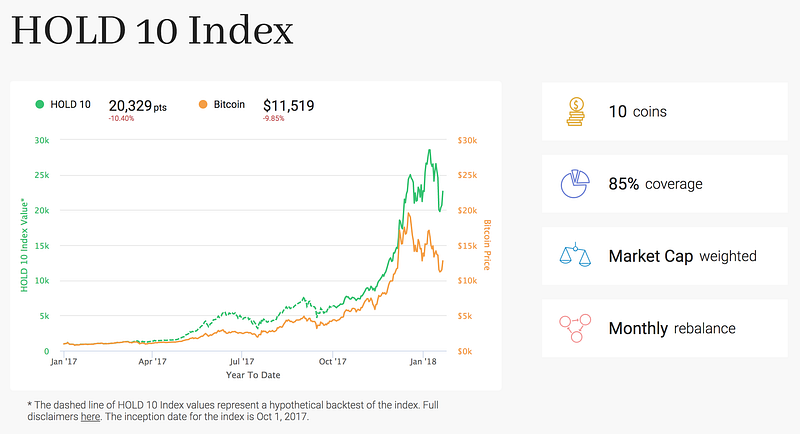
This is amazing, and it answered many of my concerns, but not all. For example:
- Hold10 will be missing on all new coins that are doing very well until they reach the top 10 by market cap. Holding a specific number of coins and ignoring everything else didn’t sound good enough to me.
- Hold10 also rebalances periodically (on monthly basis). This is good for long term buy-and-hold but not for active trading. You could be losing good opportunities of rebalancing within the month.
- Because it’s buy-and-hold for the long term, Hold10 won’t sell even if the price is too high compared to the development of the project, i.e., it’s pure speculations. An active trader would rebalance at such events by selling down to a lesser exposure.
- If one of the top 10 coins is performing very poorly, why keep seeing it going down until it goes out of the top 10, why not exit this investment temporarily until it shows signs for improvement?
- Comparing your portfolio performance to Bitcoin only is not good enough, I also want to know how good is’t performing compared to the total market cap of my selected coins.
Overall, it’s a good starting point to develop a model for active trading based on market performance, instead of gut feelings about specific coins.
—
Disclaimer: The information provided in this blog post does not constitute investment advice, financial advice, trading advice or any other sort of advice and you should not treat any of the content as such. I do not recommend that any cryptocurrency should be bought, sold or held by you and nothing on this post should be taken as an offer to buy, sell or hold a cryptocurrency. Do conduct your own due diligence and consult your own financial advisor before making any investment decisions.