
Headless, composable and agentic commerce, and who gets paid when the storefront moves.
Think about the last big thing you bought. Before you paid, you probably asked someone: a friend, a brother, a coworker who owns one.
Now people ask an AI. It remembers what they told it last month, it has read more reviews than any salesperson, and it does not hand back ten links. It answers.
For twenty years, selling online meant one thing: get the customer to your store. The store was where people searched, compared, decided and paid. Own the store, own the customer.
That assumption is breaking. In the past five weeks, Shopify opened its catalog and checkout to any agent, OpenAI gave its agents a wallet, and Visa extended its agent payment testing to merchants and acquirers. The shopper's first stop is becoming an assistant that belongs to someone else.
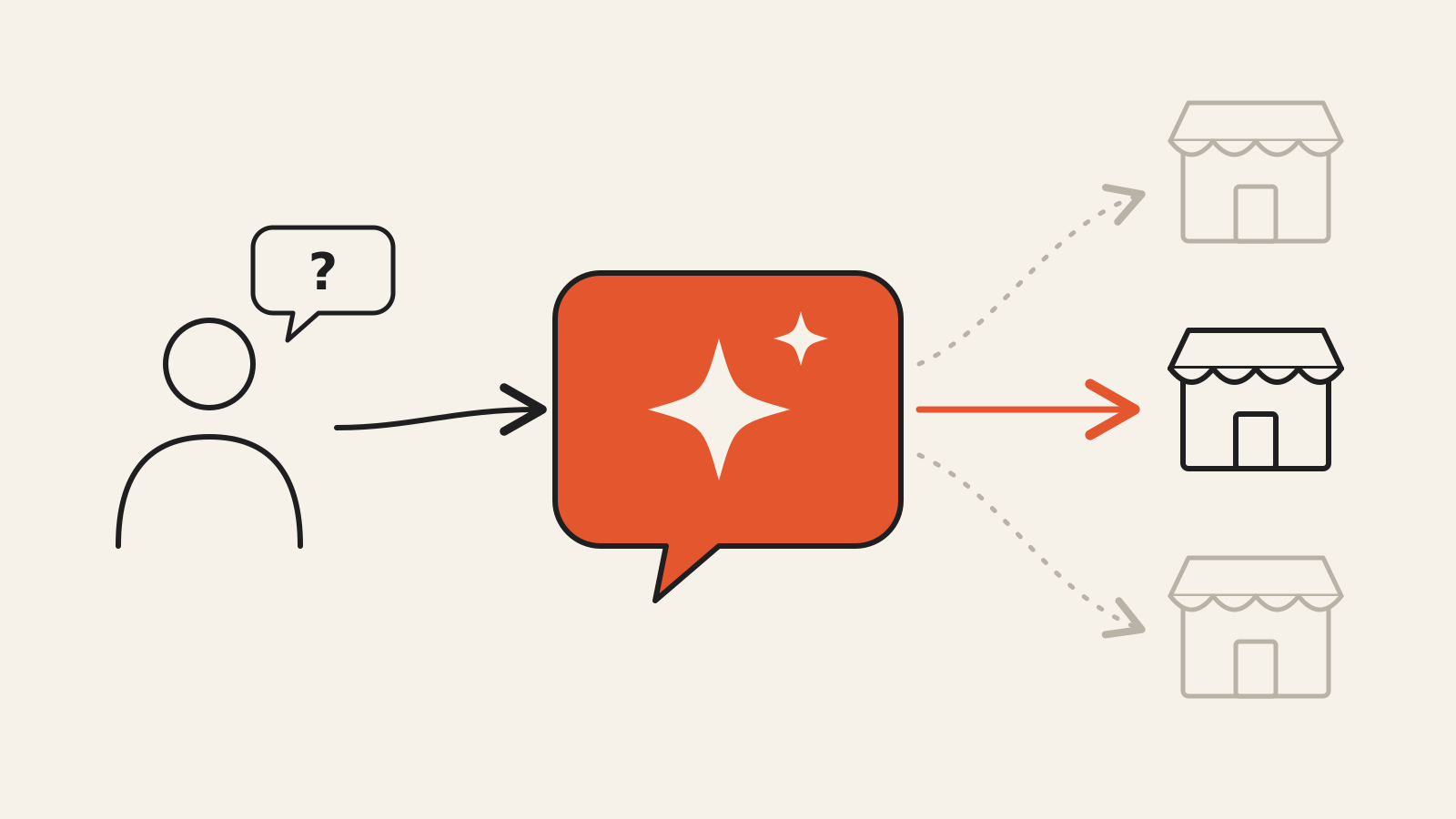
Here is my bet. Assistants will win discovery. Merchants will keep the transaction. The money will be made, and lost, in the layer between the two: the product data, permissions and payment plumbing that let one talk to the other.
Three words, one idea
Headless, composable and agentic sound like three trends. They are one idea arriving in stages: the parts of a store are coming apart.
Headless separated the storefront from the engine. A merchant builds its own website or app, while a platform underneath runs products, inventory, carts and orders through APIs. The price is real: a separate frontend to build and maintain, which Shopify's own documentation says costs more than a themed store. [1]
Composable did the same to the engine. Search, content and promotions become services a business can pick and replace. [2] Every piece adds a dependency. That is why commercetools made its Commerce Integration Layer generally available in mid-October: a hosted layer that connects those services for storefronts, mobile apps and AI agents. [3] When the glue becomes a product, you know the glue was the problem.
Agentic finishes the job. Headless made the frontend replaceable. Agentic commerce means someone else replaces it. An assistant interprets the need, compares products, builds the cart and, where authorized, pays.
Where the value goes
Buying has always started with a conversation. We asked family, friends and coworkers what to get, because they knew us and we trusted them.
Search engines changed where we found information. They never replaced that conversation. Search hands you a page of links and leaves the deciding to you.
An assistant replaces the conversation itself. It knows your budget, your past purchases and what annoyed you last time. It is awake at 2 a.m., it has read far more about the product than any friend could, and it ends with an answer.
That is why I think this shift is bigger than search. Search changed how we look. This changes who we listen to.
A merchant can still own the sale, the fulfillment and the support while another company owns the moment the customer says what they want. That is new. A search engine sent you a visitor. An assistant sends you a decision that has already been made.
So the first place value collects is the interface. Whoever hears the intent first decides which three products get compared.
The second place is less obvious and more investable: the data the assistant reasons over. An assistant cannot feel a brand. It can read specifications, stock levels, compatibility, delivery promises and return policies. Those fields used to be housekeeping. Now they are the sales pitch.
The loser is the storefront as a destination. Merchants that add their own assistants get a second route, and they still have to earn the visit first.
Five weeks of evidence
| Date (2026) | Who | What changed |
|---|---|---|
| Mid-October | commercetools | Commerce Integration Layer generally available. [3] |
| October 28 | Shopify | Shop.dev and Shop.md connect any app or agent to its catalog, cart, checkout and Shop Pay. Universal Checkout serves partners selling across many merchants. [7] |
| October 29 | Adobe | AI-referred visits to US retail sites converted 90% better and earned 83% more per visit in September. [8] |
| November 10 | OpenAI | Businesses in ChatGPT, in beta: profiles, product feeds and engagement insights, plus Business Agents for eligible US ecommerce and online service businesses. [10] |
| November 13 | OpenAI | ChatGPT Wallet for US Pro subscribers, through dots. Users approve every purchase and agents pay with tokens, never the real card details. [12] |
| November 16 | Commerce | Shopping Agent for eligible BigCommerce merchants: a customizable assistant inside the merchant's own storefront. [11] |
| November 17 | Visa | Agentic Ready extended to merchants, payment providers and acquirers. [13] |
Read top to bottom, the list is a story in three acts: connect the catalog, give the business a voice in the conversation, then make the payment trustworthy.
The standards sit underneath: Google's Universal Commerce Protocol, built with Shopify and others, and OpenAI and Stripe's Agentic Commerce Protocol. [4][5][6] Adopting one does not buy a merchant distribution in every assistant.
One caution on the Adobe numbers: they count shoppers who clicked through from an AI source. They do not measure autonomous purchases or prove that AI caused the lift.
The most instructive data point is a retreat. OpenAI launched Instant Checkout in September 2025 so people could buy inside ChatGPT. In March 2026 it handed checkout back to merchants and refocused on discovery. [15] Wallet is the second attempt, and the design has changed: the agent now pays through the merchant's existing systems. [12] The assistant took discovery and left the transaction where it was.
Three things people call AI shopping
Referral. The assistant recommends, the shopper clicks through and buys on the merchant's site. Shopify's documentation describes its ChatGPT channel this way: discovery first, checkout at the merchant's own store. [14]
Embedded checkout. The purchase completes inside the AI channel. Shopify lists eligible Google, Copilot and Meta channels as supporting it. [14]
Delegated purchase. An agent executes a purchase the user has authorized. ChatGPT Wallet belongs here, with an approval every time. [12]
Most of what is live today is the first. When someone tells you agents are buying things, ask which of the three they mean.
What I would back, and what I would not
I would back companies that keep product information accurate, current and usable across every channel an assistant might read.
I would back the unglamorous middle: verifying agents and their permissions, resolving failed transactions, and showing which AI channels produce profit and which only produce traffic.
I would be careful with pure connectors. Shopify and commercetools both shipped integration as a feature this quarter. A connector that works today is a feature waiting to be bundled.
My test is one question: how much of the solution repeats across customers? If every new merchant is a new integration project, it is a services firm with a software valuation.
The MENA question
The protocols above were designed around a shopper with a card on file. Much of this region does not shop that way, and that gap is the opportunity.
Payments. Many baskets close with cash on delivery, installments or mada. An agent that cannot offer the shopper's real payment method does not finish the purchase.
Arabic product data. Catalogs are often thin and bilingual, and shoppers search in dialect. An assistant is only as good as the catalog it reads.
Chat is already the storefront. Merchants already sell through WhatsApp and Instagram messages. What is missing is the link from conversation to inventory, payment and delivery.
Three groups will feel this differently.
Salla and Zid merchants. The long tail of independent stores cannot build agent integrations one by one, so their fate sits with the platform. If Salla and Zid make every store readable by assistants, thousands of small merchants gain a channel overnight. Salla already documents cart APIs for headless, mobile and chat experiences. [9]
Noon and Amazon. A marketplace's power is being the place where shopping starts, and agents attack exactly that. Amazon's answer globally has been to block outside agents and build its own assistant. [16] I expect the same instinct from the regional marketplaces. A walled garden protects advertising revenue today and gives up every shopper who starts somewhere else.
The big chains' own online stores. They have the most to gain. An assistant does not care how the homepage looks. It cares whether price, stock and delivery are accurate right now, and a chain with live inventory across its branches can answer what no marketplace can: who has this near me tonight?
I want to meet the teams turning one of these three gaps into a product that repeats across merchants and gets more valuable with every new interface.
Where merchants should start
Start with the bottleneck and let the architecture follow.
An experience you cannot deliver on a themed store may justify a custom frontend.
Operations too complex for one platform may justify specialized services.
Customers you cannot reach through assistants usually need better product data and integrations, with no rebuild required.
The interface is changing hands. The job is the same. Someone still has to make a product worth recommending, deliver it on time, earn a margin and give the customer a reason to come back. The assistant will notice who does.
Sources
Shopify: About headless commerce
Shopify: Composable commerce platform
commercetools: Commerce Integration Layer generally available, October 2026
Google: Under the Hood, Universal Commerce Protocol, January 11, 2026
Google: UCP updates, March 19, 2026
Agentic Commerce Protocol
Shopify: Fall '26 Edition for developers, October 28, 2026
Adobe: AI traffic generates 83% higher revenue per visit, October 29, 2026
Salla: Checkout APIs overview
OpenAI: Introducing Businesses in ChatGPT, November 10, 2026
Commerce: Shopping Agent for BigCommerce, November 16, 2026
OpenAI: Introducing ChatGPT Wallet, November 13, 2026
Visa: Agentic Ready expansion, November 17, 2026
Shopify: Agentic storefronts
Modern Retail: What went wrong with ChatGPT's Instant Checkout, March 27, 2026
RetailWire: Should Amazon Be Banning AI Shopping Agents From its Platform?, March 13, 2026