
The Case For Investing In Enterprise Blockchain
The Case For Investing In Enterprise Blockchain
Database Evolution
When investing in blockchain for enterprise, the basic abstract question to ask is: Where Do Enterprises Store Their Data? and Why?
To answer this question, we should look at the evolution of database.
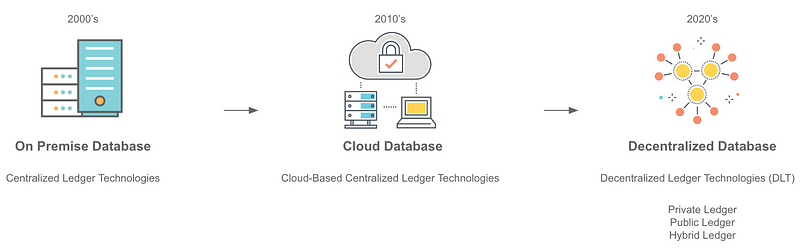
In the early 2000’s companies used to have on-premise database management, then in 2010’s, most of the companies moved to cloud-based database management. Each of these technologies has it’s own benefits, and companies shift to new tech when it solves a real problem or when it offers considerable cost reduction.
Now, we’re seeing a few companies (early adopters) moving part of their data to decentralized ledger technologies (DLT) for two main sets of benefits:
Data related benefits:
- Better efficiency
- Limitless scalability
- Less oversight
- Reduced cost
- Immutability
- Improved auditability
Business related benefits (Collaboration):
- Trustless, secure and shareable database
- Reduced Intermediaries
- Enhanced privacy
- Transparency
- Less Fraud
Why Blockchain
Well, Blockchain is:
- A decentralized database implementation. There are other technologies that are still in the research phase, such as HashGraphs and Tangles.
- It holds records of digital data or events in a way that makes them tamper-resistant.
- While many users may access, inspect, or add to the data, they can’t change or delete it. The original information stays put, leaving a permanent and public/private information trail, or chain, of entries.
How It Works?
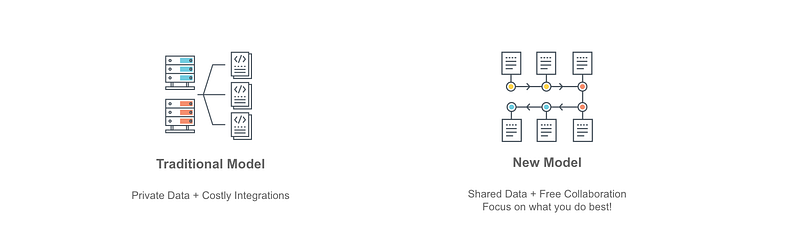
Traditional Model:
- Companies compete to create their own data, and keep it private
- They pay huge amounts to store and secure their data
- They develop costly integrations with other companies in their supply chain
- Only to be able to work together
- And they all have to trust each other
New Model:
- Companies collaborate in creating shared immutable data
- Independent Miners/Verifiers maintain the data security and data integrity, incentivized by a common coin produced as they verify new entries/transactions
- Companies pay much less to storage providers as all partners share the cost (in coins)
- Trust is not an issue anymore as the ledger is immutable and transparent!
- Companies focus on what they do best, and let the miners maintain the infrastructure.
- And this can be private (among a few partners in a specific supply chain), public (open to all), or hybrid.
Applications — Autonomous Vehicles
DAV — Autonomous Transportation Startup:
- DAV is a Blockchain-based transportation protocol, enabling a Decentralized, Peer-to-Peer, Global Transportation Network
- Drivers and passengers communicate directly with each other, with no middleman taking part of the revenue
- Supply carriers pick up material, navigate to their destination, and are paid for services autonomously
- People get a ride from an autonomous car or share your own car on the network and earn DAV Tokens
Applications — Supply Chain
Chronicled — Supply Chain Management Startup:
- Chronicled gives industries and enterprises the tools to build blockchain powered supply chain ecosystems with built-in trust, automation, and privacy.
TEMCO — Supply Chain Management Startup:
- TEMCO focuses on SMEs who do not have sufficient infrastructure or financial flexibility to offer supply chain management data to their customers.
These two companies helps enterprises manage private supply chain networks in:
- Recording the quantity and transfer of assets — like pallets, trailers, containers, etc. — as they move between supply chain nodes
- Tracking purchase orders, change orders, receipts, shipment notifications, or other trade-related documents
- Assigning or verifying certifications or certain properties of physical products; for example determining if a food product is organic or fair trade
- Linking physical goods to serial numbers, bar codes, digital tags like RFID, etc.
- Sharing information about manufacturing process, assembly, delivery, and maintenance of products with suppliers and vendors
Applications — Healthcare
Nebula — DNA Data Startup:
- Nebula gives people complete control of their DNA data. People can choose to keep it private or they can get rewarded for securely and anonymously sharing it with medical researchers.
- Nebula also provides DNA sequencing kits, where they read more data than 23andMe or AncestryDNA for research purposes
- And it matches people with research institutions that will cover the cost of their genome sequencing.
Patientory — Collaborative Patient Data Startup:
- Patientory empowers patients, clinicians, and healthcare organizations to access, store and transfer information safely, thus improving care coordination while ensuring data security.
- It uses blockchain technology to ensure end-to-end encryption while adhering to regulatory guidelines and compliance requirements.
Applications — Insurance
Etherisc — Decentralized Insurance Startup:
- Blockchain-based insurance protocol, enabling a Decentralized, Global Insurance Network
- When certain conditions are met, for example a flight delay, a category 5 hurricane, or loss of crop according to weather report and a satellite image — a self-executing smart contract triggers near-immediate payout.
Applications — Energy
Greeneum — Decentralized Energy Grid Startup:
- Greeneum records the green energy that a household or a utility produces and issues Greeneum Carbon Credits and Green Certificates.
- The entire process is fully automated with a GreenPET setup that also records and validates energy production on the blockchain.
- The Carbon Credits and Green Certificates trade on the open market for either the native cryptocurrency GREEN, or any other cryptocurrency or fiat.
- Additionally, Greeneum has a marketplace wherein people can buy smart devices for energy usage and installations that produce renewable energy.
Applications — Pharmaceuticals
BlockPharma — Drug Traceability Startup:
- BlockPharma allows pharmaceutical companies to collaborate by sharing their data while preserving their confidentiality.
- It’s app allows consumers to instantly check the authenticity of the drug box they buy
- It also uses machine learning technologies to improve the detection of counterfeit cases.
Who’s Investing
The above mentioned started have attracted capital from top tier VC firms, equity crowd investors, and ICOs/STOs investors.
For example, DAV raised more than $80m from Kleiner Perkins and Goldman Sachs! Nebula Genomics raised more than $4m from Khosla Ventures. Chronicled raised $12m from Broadway Angels, Mandra Capital, and Colbeck Capital. TEMCO is funded by Korea Investment Partners, the largest VC in South Korea! While Patientory raised more than $7m through equity crowd-sale!
The Enterprise DLT Decade IS Coming
The history is full of stories of new tech companies, that do not attract attention at first as skepticism is loud. But they keep working silently, funding by smart investors who can discover new trends, and then suddenly they dominate big markets.
Although DLTs was initially intended for financial transactions with Bitcoin and other crypto currencies, now, businesses of all kinds are getting creative with these decentralized ledger technologies, as it can be used to record, track, and verify the movement of anything that holds value. From ride-sharing to cloud storage to voting, companies in all industries are beginning to see DLT’s potential.