
Token Funds: New Breeds of Assets, New Breeds of Funds
Token Funds: New Breeds of Assets, New Breeds of Funds
The Newborn from Venture Capital and Hedge Funds In Crypto
In a previous post, I listed various types and strategies of investment funds, including venture capital and hedge funds. The fast-paced evolution of crypto funds this and last year presents us with new hybrid models that might change the face of both!
The Evolution of Tokens:
let’s start with quick definitions.
Money is:
- Store of value (save it and use it later)
- Unit of account (provide a common base for prices)
- Medium of exchange (used to buy/sell from/to others)
A Security is: (according to the Howey Test)
- An investment of money,
- In a common enterprise,
- That relies upon the work of others,
- With an expectation of profits.
Digitization:
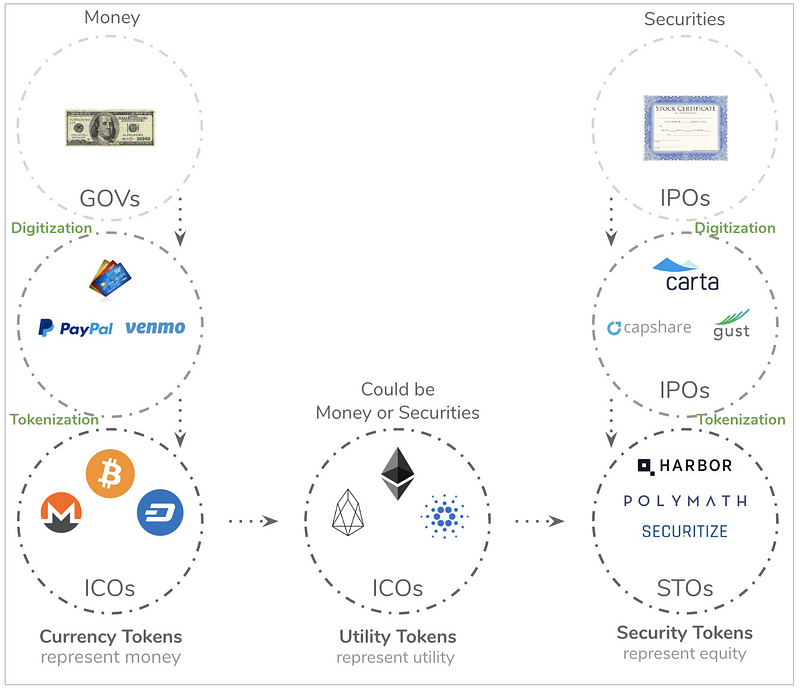
When Money got digitized, we got Visa/MasterCard, PayPal, Venmo, … as platforms that help people use their money in a digital form.
When Securities got digitized we got Carta, CapShare, GustLaunch, … as SEC-compliant platforms that help private companies issue and manage their certificates in a digital form.
Tokenization:
- Currency Tokens
When Money got tokenized, we got Bitcoin, Litecoin, Monero, Dash, … as platforms that help people use their money in a token form, a Currency Token (as per the definition above) that represents money, and can be used for payments, usually referred to as Crypto Currency Tokens.
- Utility Tokens
With the tokenization of money, we also got a new type of assets that could be securities at times (in case of a SAFT, SAFTE, Token DPA , R-Token or a direct ICO), and then shifts to be legally considered as “Virtual Currencies” (regulated by FinCEN) after launching the platform, this is the Utility Token.
It’s a token that represents a utility when using a specific decentralized product or service. An example is using Ether coins to access Ethereum’s computing platform. Other examples include: EOS, Stellar, Cardano, Filecoin, Lisk, Steem, ….
I would argue that this new type of tokens also represents ownership, not in the equity of a platform, but in the decentralized economy and community of the platform, more on this in: ICOs: From Asset Ownership To Economy Ownership.
- Security Tokens
When Securities got tokenized we got Polymath, Harbor, Securitize, TokenSoft, Republic…. as SEC-compliant platforms that help people issue and manage their certificates in a token form, a Security Token (as per the definition above) that represents equity, debt or other types of securities.
Why tokenize you company? That’s a whole other subject, maybe for another blog post, but we’re seeing many companies going that route. Companies like MintHealth, Spin, IPwe, … have already moved to token shares, and raised money via STOs (Security Token Offering) from accredited investors, instead of going the long traditional route of an IPO.
Not only companies, some funds have also been tokenized and raised money form LPs via STOs, SparkLabs, 22X-500Startups, SPiCE, and Blockchain Capital are examples of VC firms with such funds, and Crypto20 and TokenFund are examples of Crypto funds that are tokenized as well.
There are also now SEC compliant exchanges (according to their websites) created specifically to trade Security Tokens such as: OpenFinance, MCEX, tZERO, and Templum, …. with Coinbase joining the wagon soon. OpenFinance claims to have 130+ Security Tokens in Pipeline Representing $6 Billion in Value.
The Evolution of Token Funds:
With all these developments in Tokens as new types of assets, investment fund managers had to catch up.
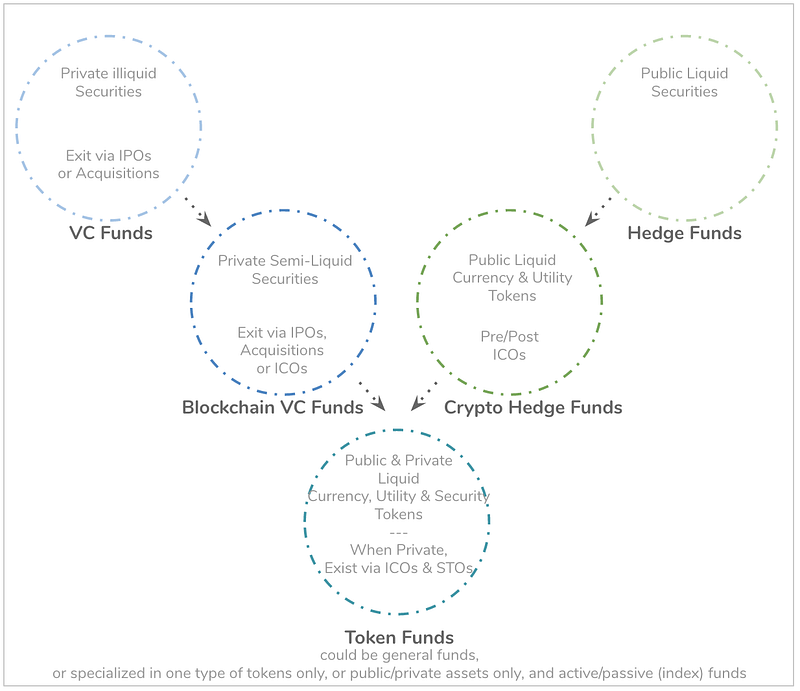
It started when some VC funds started investing in Blockchain startups (traditional equity investments), then those startups launched their own ICOs for either Currency or Utility Tokens! That was an opportunity for early liquidity for the funds, in case they decided to trade their equity stake with the startups’ utility tokens/coins. This encouraged some VC fund managers to start short-termed Blockchain dedicated funds to invest in equity and/or ICOs, then exit or sometime even trade their crypto assets (tokens) post-ICO in the market.
On the other side, hedge fund managers were also looking at the exploding number of new Currency Tokens and Utility Tokens being trading publicly with unprecedented returns! They started crypto hedge funds dedicated to trade currency and utility coins and in sometimes even invest in ICOs.
This created a new hybrid model, called Crypto Funds, that inherited strategies from both VC funds and Hedge funds in what Multicoin Capital calls: “Venture Capital Economics With Public Market Liquidity”.
Now, with Security Tokens (that are more liquid than Paper or Digital securities) added to the mix, Crypto Funds are evolving to become Token Funds. It’s a VC and a Hedge fund at the same time.
A Token Fund:
- Invests and/or trades in one, two or all three types of tokens (currency, utility, security).
- Invests in private tokens (pre-ICO, pre-STO, i.e., more venture-like) and/or trades public tokens (post-ICO, post-STO, i.e., more hedge-like).
- The fund itself can also be tokenized, meaning the LP interest of the the fund is represented by a tradable token, which in turn represent an array of portfolio tokens, and valued by the NAV of that array.
- Needless to say, there is no need for underwriters, or broker-dealers when a token fund invests pre-ICO or Pre-STO.
To start a token fund, you truly need technical expertise from both worlds, VC and Hedge funds.
Opportunities
This doesn’t mean that older types will disappear, on the contrary:
- Institutional investors will keep investing in traditional stock-market hedge funds, traditional VC funds, and in all new types of token funds. It’s a great opportunity for more diversification in their portfolio of funds.
- It’s also a great opportunity for new fund managers to build technical expertise and excel in new fund types as traditional funds will move slowly into these new breeds of funds.
Personally, I think security token hedge funds, powered by AI, to collect and process data on private companies performance in order to create models that estimate token values, will be the next big thing in just a few years.