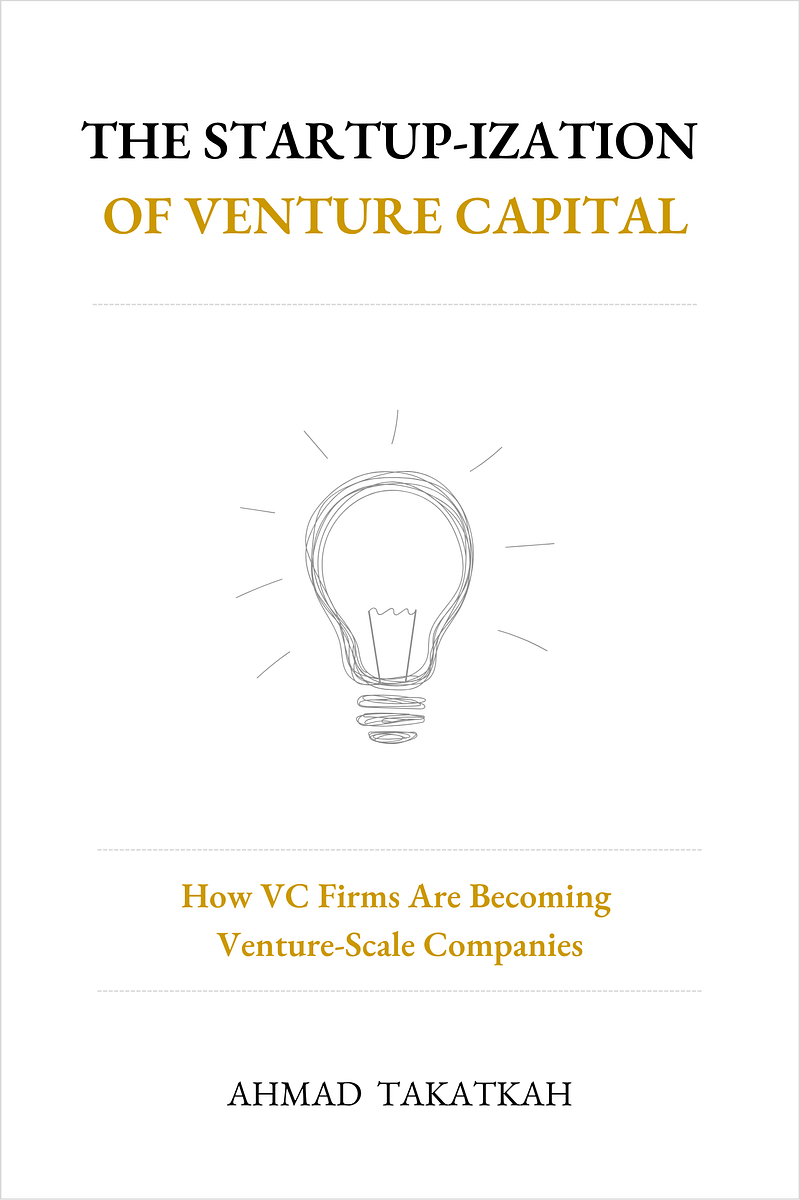
The Startup-ization of Venture Capital
The Startup-ization of Venture Capital
Why VC Firms Are Now Acting Like Startups — and Raising Capital Like Them Too
For decades, venture capital firms existed to fund startups.
Today, the most ambitious VC firms are startups.
They’re hiring engineers and PMs. Raising capital for the firm, not just the fund. Building internal tools and platforms. Operating with fintech-style UX, AI automations, and scalable infrastructure. They’re not just investors anymore — they’re venture-scale companies.
📄 That’s why I wrote this new whitepaper:
👉 The Startup-ization of Venture Capital
What’s Changed — And Why It Matters
The traditional VC model — slow, opaque, and partner-led — simply can’t keep up with the speed, transparency, and complexity of modern private markets.
New tools. New stakeholders. New expectations.
Founders want fast decisions, clear value, and secondary liquidity. LPs want co-investment access, data-rich dashboards, and institutional service. And now, accredited and retail investors are entering through SPVs, rolling funds, and secondary deals — expecting consumer-grade UX.
All of this is forcing VC firms to reinvent themselves — not just as capital allocators, but as full-stack financial service platforms.
VC Firms Are Raising Rounds Now — And That’s a Feature, Not a Bug
A few years ago, the idea of a VC firm raising a round would have sounded odd. Today, it’s a smart move.
Just like startups raise capital to build product and scale fast, modern VC firms are raising GP-level equity to:
- Build proprietary dealflow and data infrastructure
- Launch internal tools, dashboards, and liquidity products
- Serve multiple customer classes (LPs, founders, employees, retail investors)
- Monetize beyond fees and carry
- Create long-term platform value
Firms like AngelList, Tribe Capital, and EQT Ventures, are showing us the way. They’re not just backing innovation — they’re building it, from the inside out.
A Moment of Validation
Last week, Henry Ward (CEO of Carta) testified before Congress on how to expand access to venture capital. He cited two new bipartisan bills — the DEAL Act and the ICAN Act — that would let VC firms invest in other VC firms and secondaries more freely.
This wasn’t the inspiration for the whitepaper — but it was powerful validation.
The industry is waking up to the fact that VC firms themselves need capital, tooling, and innovation to evolve. The legislation is catching up to a movement that’s already well underway.
Read the Full Whitepaper
If you’re building or backing the next generation of venture firms, this is for you.
📥 Read the whitepaper here: https://www.vcpreneur.com/the-startup-ization-of-venture-capital-white-paper
Let’s rethink what a VC firm can be.
Not a boutique. Not a spreadsheet.
But a startup.