
The Agile Living Canvas
The Agile Living Canvas
An entrepreneurial approach to living
The Why?
In the startup world, a startup is defined as: “an organization in search for a repeatable and scalable business model. When that business model is found, the startup transitions to a company, where it shifts from search to execution” Steve Blank.
Well, in that context, humans could be defined as: “beings in search for experiences through interests. Over time, some of those interests become passions, and then evolve to be life missions”.
In this post, I am sharing an agile approach to experience interests, visualize them, find passions, and develop missions.
The How?
First, let’s agree on a simple concept:
To Live = To Experience
An entrepreneur starts a company to create a product that solves a problem or offers a new value, not to be an entrepreneur.
Similarly, we should not aim to “be” something in our lives, we should aim to “do” something. Ideally to contribute or add value in our own ways through our own experiences.
But to simplify this and be able to know what to “do”, let’s use the verb “experience” instead. So “we live in a journey aiming to experience some things”. Now, how do we experience things? and what are those things we want to experience?
I’ve always struggled with the words: hobby, passion, and mission. Hobby for example, never made sense to me! I never had a long term hobby in the conventional meaning.
When it comes to passion and mission, we always use them in a singular form, why?! Can’t we have more than one passion? or more than one mission? I think we can.
So let’s start with the word: interest.
- An interest doesn’t define you, you could get interested in anything as a result of interacting with people or with nature or any other reason, and you could lose that interest at any point,
- an interest is dynamic, your interest in something can increase or decrease,
- and an interest doesn’t have any commitments attached to it.
There you go, the things you want to experience are: “your interests” (in plural).
Now let’s breakdown the verb experience. When you get interested in something, you go through five stages (as verbs):
- Explore:
You’re curious to know more about this, so you start exploring and observing. - Connect:
As the level of interest increases, you start connecting with people who share the same interest, make friends and engage in related conversations. - Learn:
At this point, you start learning more about that interest of yours by reading more about it, learning a related skill, experimenting on my own, attending related events, enrolling in special trainings, or getting an educational degree. - Contribute:
If your level of interest increase even more, you start contributing to it by solving a problem, develop a theory, innovating a new thing, writing a book, an article, making a video or a movie, etc… As a result of your contribution, you could get rewarded by recognition, money, fame, or just by your personal satisfaction of adding value. - Give:
At this point, you feel the gratitude towards the community around you, and you start giving back.
As much as I love this, but it looks like a perfectionist waterfall approach to experience something. Let’s transform it into an agile model by adding a feedback loop, and by adopting an MVP mentality to the 5 steps above.
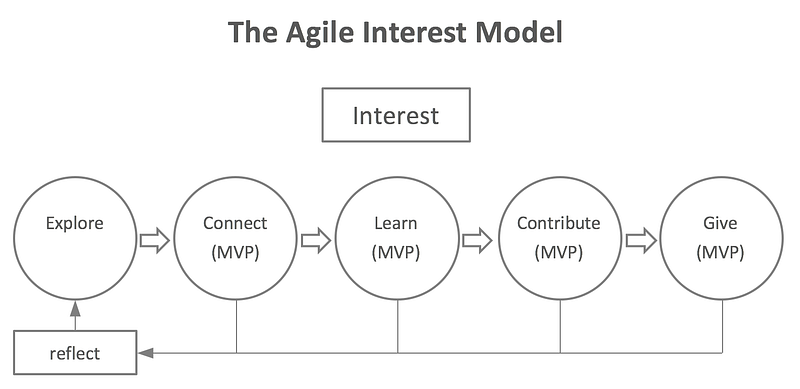
In this model, you won’t need the useless planning to force yourself to commit to something, and then after years of working on it, you discover that you’re not truly interested in it. You just do and enjoy doing what you truly like to do and opportunities will come along the way.
In addition, by reflecting on every step in the process, you will learn more about your own level of interest, the people who are also interested in the same thing, the needed skills, what and how you can contribute, and what and how you can give back.
MVPing every step will insure that you’re not being a perfectionist. In every step, you’re just getting enough to be able to reflect and move to the next step.
Interests could be: Science, Art, Music, Sports, Cars, Food, Photography, Religion, Politics, Health, … But the more specific you are, the closer you would be to discover your true self. You could be interested in a general topic, and be exploring multiple field within that topic separately until you find your match. Here are some examples:
- Science/Computer Science/Cryptography and cyber security or Artificial Intelligence if you well.
- Art/Movies/Animated Movies
- Music/Jazz
- Beauty/Makeup
- Sports/Martial Arts/Karate
- Cars/Sports Cars
- Religion/Monotheistic Religions
- FinTech/Stock Market Investing
- Food/Cooking/Ethiopian Food
- Languages/Spanish
- Games/Computer Games
- …..
The What?
I am suggesting the following: “Agile Living Model” as a tool to navigate your way through your interests to enjoy your life journey, find passions, and then develop missions to work on.
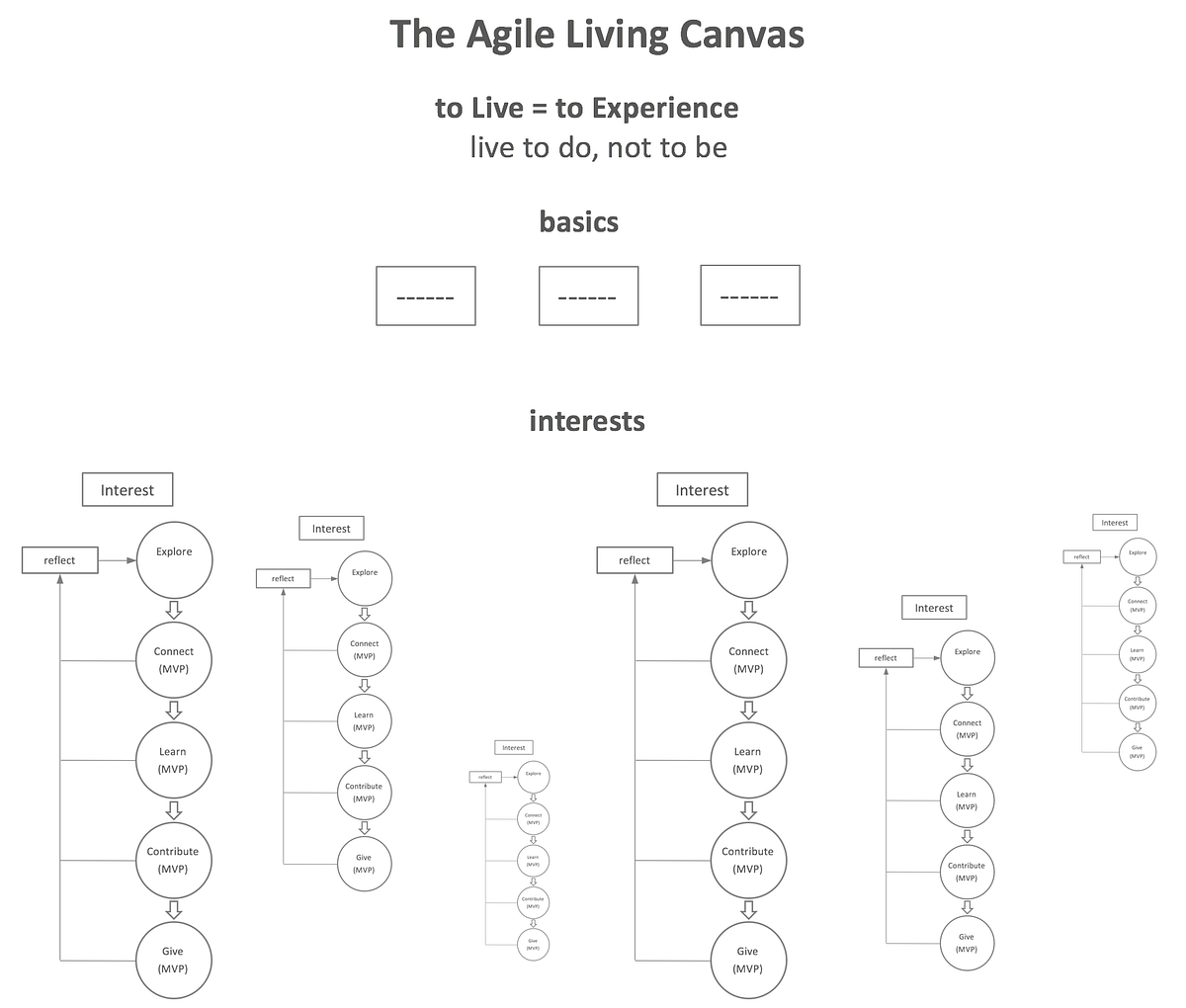
In the canvas above, you can have as many interests as you want, no borders, no limitations, and no commitments, responsibilities or attachments. You can add or remove interests whenever you want. You can represent your interest level by the size of the interest block, which you can increase or decrease as you go.
Over time, as you find yourself naturally investing more time and effort in some interests more than others, you will start prioritizing some over others. And later on, you will find yourself so passionate about a few of them that you start thinking about developing a life mission to contribute to those particular interests.
Having a passion and a mission towards something doesn’t mean that you stop having other smaller interests that you enjoy doing. It just means that you give the bigger interest (which is now passion/mission) more time and effort.
There is a section in the canvas called: “basics”. In there you can add all the basic needs you might think of to be able to have interests in the first place. For me this includes: Health (mental and physical), Safety, Freedom, and Family.
I hope you found this post helpful. If you did, I would really appreciate recommending and sharing it with others so they can also benefit.