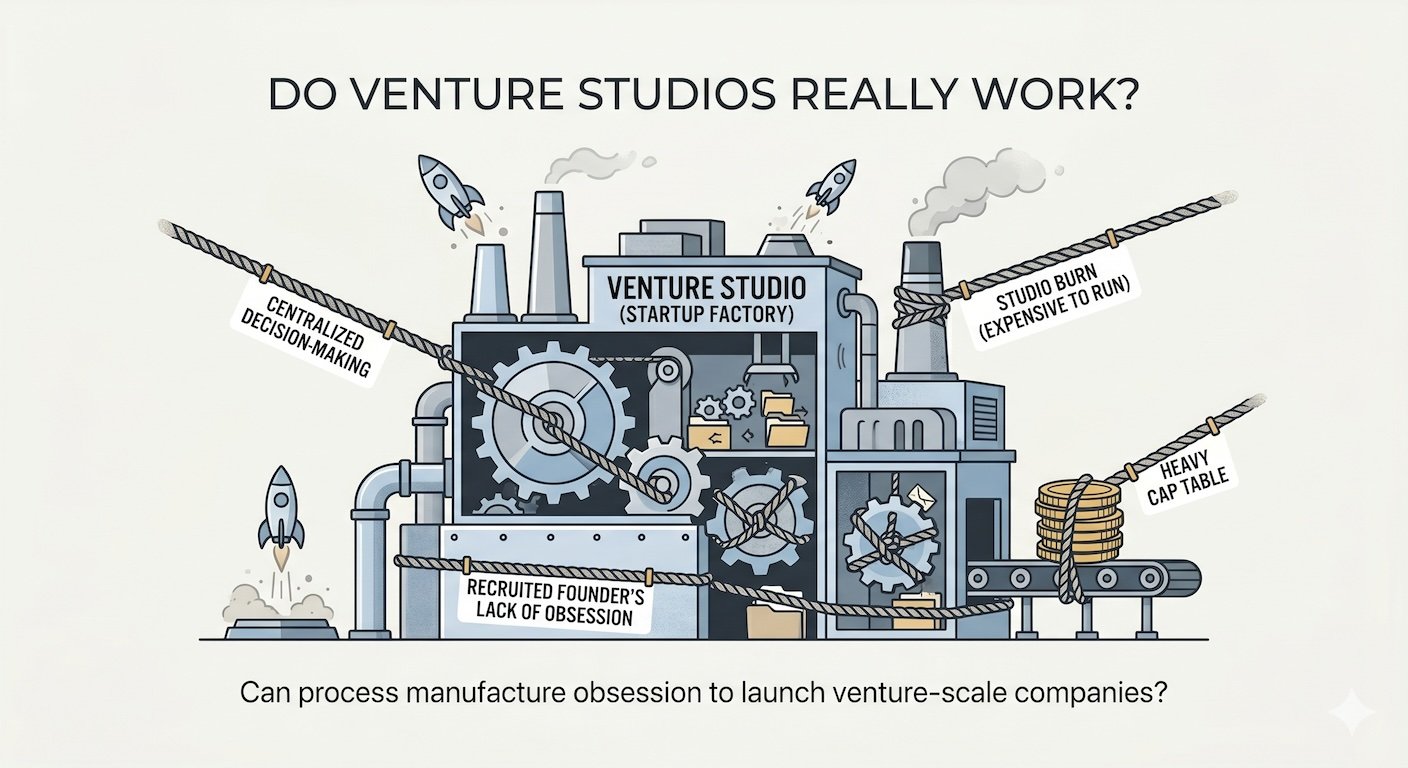
Venture Studios Sound Great. But Do They Really Work?
I like the idea of venture studios.
In theory, they make a lot of sense.
Instead of waiting for founders to show up with ideas, a studio creates companies from scratch. It identifies opportunities, validates ideas, builds early products, recruits founders, provides shared services, and helps launch multiple startups under one roof.
It sounds smarter than traditional VC. More structured. More repeatable. Less random. And that is exactly why the model is attractive.
But I am still skeptical, especially when it comes to standalone venture studios. Not because the model can never work. It can. Some studios have produced strong companies. But I think many people underestimate how hard it is to build venture-scale startups this way.
Why Venture Studios Sound Like a Good Idea
There are real reasons why people like the model.
First, venture studios can be more proactive than VCs. Instead of waiting for deal flow, they create their own.
Second, they can test multiple ideas quickly. A studio can validate markets, speak to customers, and kill weak ideas before forming a full company.
Third, they give startups shared resources. Product, design, engineering, finance, legal, hiring, and fundraising support can help founders move faster in the early days.
Fourth, they may reduce some early execution risk. A first-time founder does not have to figure out everything alone.
Fifth, they can create companies around markets that are clearly broken but do not yet have obvious founders attacking them.
So yes, the model has logic. But logic alone does not build great startups.
The Problem With Standalone Venture Studios
My biggest issue is the founder problem.
In many venture studios, the idea comes first and the founder comes later. The studio identifies the opportunity, shapes the concept, and then recruits someone to run it. But is that person really a founder? Or are they more like an employee with founder branding?
That distinction matters.
Founders are usually obsessed with a problem before anyone gives them permission to build. They have founder-market fit. They have emotional ownership. They are willing to suffer for years because they believe something should exist.
A recruited founder may be talented, but they may not have that same level of obsession. And when things get hard, that matters.
Another issue is ownership.
If the studio takes too much equity early, the founder may start the company already feeling like a minority owner. They are expected to act like founders, but economically they may not feel like true owners.
That creates problems later.
VCs may hesitate to invest because the cap table is already heavy. They may worry the studio has too much control. They may question whether the founder has enough incentive. They may wonder whether the company can stand on its own.
There is also an adverse selection issue.
Founders often want to start their own companies. They want control, ownership, and freedom. So a studio has to ask: are we attracting exceptional founders, or people who want a safer path into entrepreneurship?
That does not mean studio founders are weak. Many are excellent operators. But being an operator and being a founder are not always the same thing.
Another problem is that the studio itself becomes expensive to run.
You need capital, talent, shared services, recruiters, engineers, designers, legal support, and enough runway to create multiple companies before any of them produce returns.
So now you are not just building startups. You are also building a startup factory that itself needs funding. That is a very hard business.
Other Arguments Against the Model
There are a few more concerns.
Speed. Studios can look efficient, but decision-making may become centralized. Founders may need approval from studio partners, committees, or internal teams. That can slow things down.
Lack of authenticity. Customers, hires, and investors may feel the company was manufactured rather than born from real founder insight.
Portfolio conflict. If one company starts winning, does the studio give it all the resources? Or does it keep spreading attention across new ideas?
Fundraising friction. External VCs may not want to fund a company where the studio owns too much, controls too much, or still provides critical functions.
Cultural dependency. A startup needs to build its own culture. If too much of the company lives inside the studio, it may struggle to become independent.
So the question is not: can studios launch companies? They can. The question is: can they launch companies that behave like real venture-backed startups? That is much harder.
Where Venture Studios Might Actually Work
This is where I think corporate venture studios become more interesting. A standalone studio may have process, talent, and capital. But a corporate venture studio may have something much more valuable: unfair advantage.
A large company may already have customers, data, distribution, infrastructure, licenses, regulatory knowledge, supply chains, brand trust, and deep industry access.
That changes the game. And maybe more importantly, the goal is different.
A standalone venture studio usually needs to create venture-scale companies. It needs big outcomes. It needs external investors to believe the companies can become huge. It needs follow-on funding. It needs the startup to look attractive to VCs.
But a corporate venture studio may not need to play that game. The goal might not be to create unicorns. The goal might be to create new revenue streams, test new markets, launch strategic experiments, improve internal capabilities, defend against disruption, or build optionality for the parent company. That is a totally different game.
In that setup, the people running the ventures may not need to be founders trying to disrupt the industry from the outside. They may be entrepreneurial operators who actually want to work with the corporation, understand its assets, and build around its strengths.
They are not trying to attack the corporate parent. They are trying to help it evolve. And that distinction matters.
A bank can build fintech ventures with real access to financial infrastructure.
A telecom company can build identity, communication, or connectivity startups using its network and customer base.
A healthcare company can build healthtech ventures around real workflows, provider relationships, and patient needs.
An energy company can build climate or industrial ventures using assets and expertise that normal startups cannot easily access.
In this case, the studio is not just creating startups from a whiteboard. It is turning underused corporate assets into new ventures. That makes more sense to me.
The Case For Corporate Venture Studios
Corporate venture studios can work because they may start with real problems, not imagined ones.
They can give new ventures a first customer.
They can provide distribution.
They can reduce regulatory and market-access risk.
They can offer credibility.
They can help validate demand faster.
And they can create strategic value even if the company does not become a unicorn.
That last point is important. A standalone studio usually needs venture-scale financial outcomes. A corporate studio may also benefit from new revenue lines, defensive innovation, data advantages, ecosystem positioning, or internal transformation. So the return profile can be more flexible.
But Corporate Studios Can Also Fail
Of course, corporate venture studios are not magic.
They can easily become innovation theater.
The corporate may move too slowly.
Internal politics may kill bold ideas.
The venture may become too dependent on the parent company.
The founder may become a project manager.
The startup may be forced to serve corporate strategy instead of market demand.
So the model only works if the new venture has independence.
It needs real founders or founder-like operators.
Real equity incentives.
Freedom to sell outside the parent company.
Clean governance.
A path to raise external capital, if that is part of the strategy.
And enough distance from corporate bureaucracy.
Otherwise, it is not a startup. It is just a corporate project with a startup logo.
My Take
I am not against venture studios. I am against pretending they are easy. The model sounds good because it promises to make startup creation more repeatable. And as investors, we love repeatability. But venture-scale companies are rarely created by process alone.
They need obsession.
Ownership.
Speed.
A weird founder insight.
A culture that feels alive.
A reason to exist.
Standalone venture studios often struggle because they try to manufacture these things. Corporate venture studios may have a better shot because they can start with unfair advantages that normal startups do not have. And even then, they may not need to be judged by the same standard. A corporate studio might not be trying to produce the next unicorn. It might be trying to produce a new business line, a strategic experiment, a product extension, a new distribution channel, or a future growth option.
That is not the same game as VC.
So maybe the real question is not:
“Can we build a startup factory?”
Maybe the better question is:
“What unfair advantage can we give an entrepreneurial team that makes this new venture almost impossible for others to copy?”
That, to me, is the more interesting version of the venture studio model.